The short answer
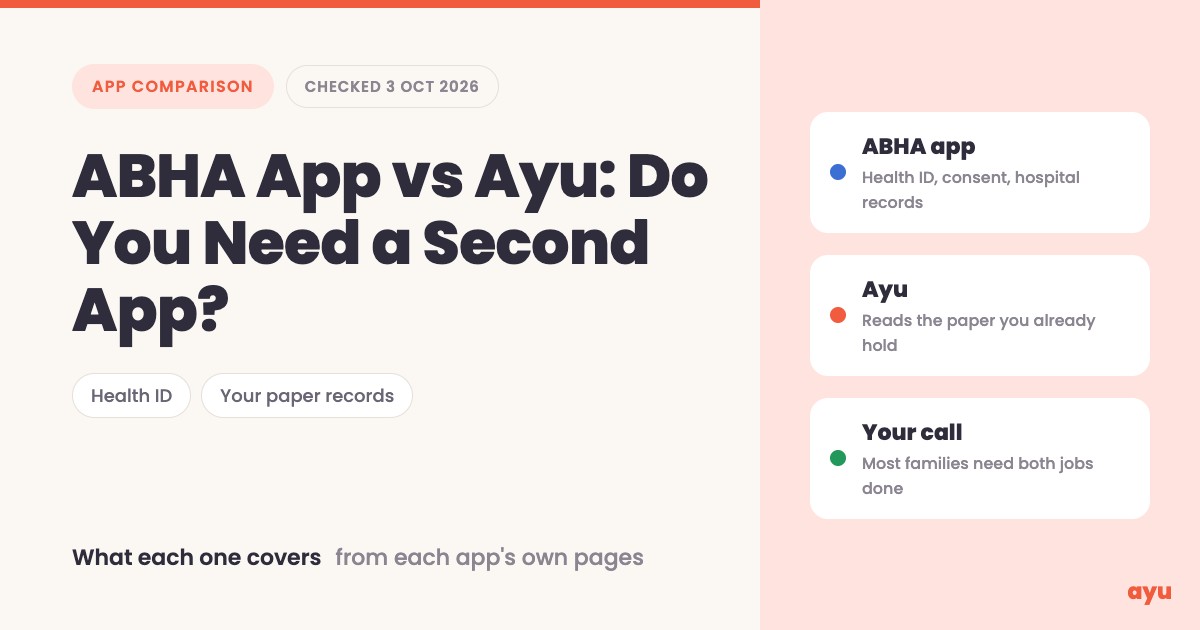
The ABHA app is the government's free app for your health ID. It shows records that ABDM-linked hospitals and labs send to you, and lets you control who sees them. It does not read the paper prescriptions already in your drawer. Ayu does that part. Most families end up needing both jobs done.
Disclosure first: we make Ayu, so we are not neutral. The ABHA app is public infrastructure run by the National Health Authority. It is free, has no ads, and Ayu does not replace it. Facts about it below come from its Play Store listing, its privacy policy and the app itself on our test phone, read on 3 October 2026.
Key takeaways
-
Two different jobs. The ABHA app is an identity and consent app. Ayu is a reading and organising app for documents you hold.
-
Records arrive in ABHA only from ABDM-linked facilities. Neighbourhood clinics and small labs often hand over paper, and paper does not reach ABHA by itself.
-
We could not confirm that the ABHA app reads inside a document. Its listing does not describe it, so we make no claim either way.
-
ABHA inside Ayu is a plan, not a feature. It is planned for November 2026 and is not live as of 3 October 2026.
-
The ABHA app now points you to Aarogya Setu 2.0, the National Health Authority's newer app, where ABHA services continue.
-
Use the ABHA app if you need an ABHA address, want an OPD token at a government hospital by scanning a QR code, or want to approve a hospital's request to see your records.
-
Use Ayu if your records are mostly paper and PDFs from clinics and labs that never sent anything to ABHA, and you want them read, ordered and explained.
-
One-app option, coming: ABHA creation and linking inside Ayu is planned for November 2026. It is not live as of 3 October 2026.
ABHA number, ABHA address, PHR app, ABDM: what each word means
Four terms get mixed up. Here they are in plain words, using only what the official pages and our ABHA explainer say.
| Term | What it is | Where you meet it |
|---|---|---|
| ABDM | Ayushman Bharat Digital Mission. A national digital health programme launched by the Government of India in 2021, run by the National Health Authority | Hospitals and labs say "ABDM-linked" or "ABDM-compliant" |
| ABHA number | A 14-digit health account number that stays with you for life. It is voluntary. It is separate from your Aadhaar number, which is used only to verify who you are | The ABHA card, and the portal where you create it |
| ABHA address | A short, easy-to-remember username in the form username@abdm, used to log in and to be found by facilities. The ABHA app's listing says you can create one with a mobile number, email or ABHA number | The login screen of the ABHA app |
| PHR app | A "personal health record" app. It is the app on your phone where you see records that facilities have linked to your ABHA, and where you give or refuse consent | The ABHA app is one. The ABDM partners page lists others, and Aarogya Setu is on that list |
Having an ABHA number does not fill your records by itself. A record appears only when a facility on the network links it to your ABHA, with your consent. And a PHR app is not a records app that reads documents: it shows what the network delivers.
If you have an ABHA number and cannot log in, see ABHA login and card download: fixing OTP and Aadhaar problems. If you are deciding between the government's apps, read Aarogya Setu vs the ABHA app. For a longer list, see which ABHA app to use.
What each app is built for
The ABHA app is published by the National Health Authority, New Delhi. Its Play listing shows a first release on 22 December 2020, and the latest version on our phone was 3.3.4-Hindon (updated 10 September 2026). Its package name still begins "ndhm", from the older National Digital Health Mission name. The business model is simple: it is a public service. The listing shows it is free, has no ads and has no in-app purchases. It does not sell lab tests, medicines or insurance in the pages we read.
Its own description says it gives "a longitudinal view of health records" with an option to link and share after you consent through the ABDM network. In practice that means three things: your ABHA address, a list of records that facilities push to you, and a consent screen.
Ayu is a medical records app from a private company in India. It has been on Google Play since 16 March 2025 and the public version is 0.2.12. It is a newer, smaller app than the ABHA app, and we say that plainly. Its job is the paper you already hold: scan or upload it, let AI read it, and see it as a medical history. Ayu is free to use. Ayu has no ads and will not add them. The only thing Ayu charges for is the family plan, from ₹99 a month, which adds profiles for family members.
The two apps, job by job
Getting records in
ABHA app. Records come through facilities. The listing says you can "link" facilities, and its screenshots show a Linked Facilities screen with a "Link new facility" button and a notification that reads "A new care context has been linked to your account". A care context is simply the hospital's record of one visit. The listing names lab reports, prescriptions and CoWIN vaccination certificates as the kinds of record you can see. One screenshot shows a blue upload button on the My Records screen, but the listing text does not describe uploading your own documents. We could not confirm self-upload, so we do not claim it either way.
Ayu. Records come from you. Scan with the camera, or upload photos and PDFs. Ayu uses AI to read documents and sort them by type, date and doctor: prescriptions, lab reports, scans, discharge summaries and bills. Ayu's AI attempts handwritten as well as printed prescriptions; always check the extracted details against the original.
Where the records come from
 ABHA app
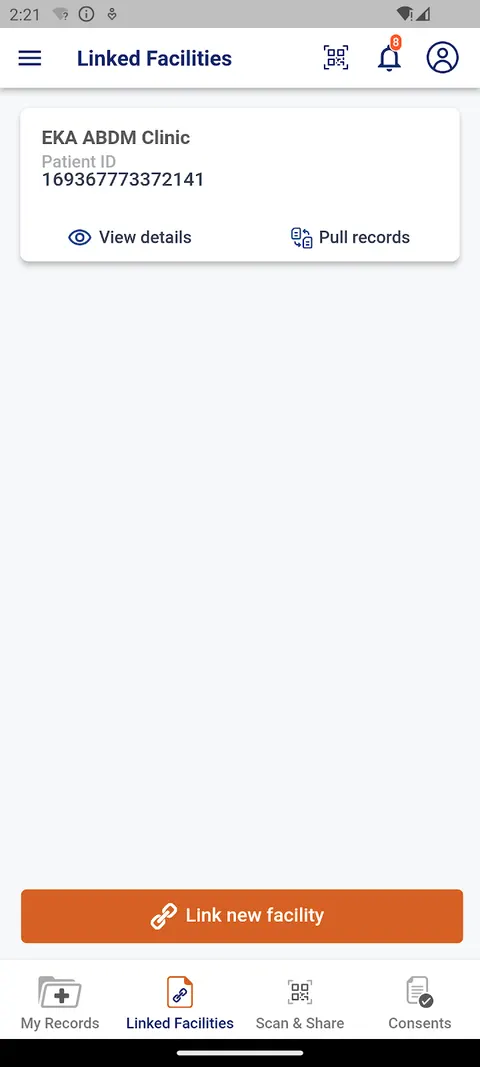
Records come from facilities you link. The hospital sends them.
 Ayu
Ayu


Records come from you. Any clinic, any lab, any year.
- 1 Photograph it
- 2 Ayu reads it
- 3 It joins your history
Reading what is inside a record
The ABHA app's listing does not mention reading the contents of a document, turning a prescription into a medicine list, or answering questions about a report. We read that as "not mentioned", not "missing". The records it shows are whatever the facility sent.
Ayu pulls out medicines, timing, doctor and date. Each uploaded document gets a plain-language summary. You can also ask Ayu questions in plain language. Answers draw on your own uploaded records, and chat can show the Sources, which means the documents it used. Answers are not medical advice. Chat asks for your consent to use AI features first, and chat needs internet.
Finding a record later
In the ABHA app the home screen lists "My health records" and a search box that says "Search your hospital or clinic". In the listing screenshot the list is grouped by date, with a facility name on each row. So you find a record by remembering which hospital issued it.
Ayu's Medical History is a timeline. Records are grouped under months, newest first. A month strip sits above the list. As you scroll, the strip moves to the month you are reading, and tapping a month jumps the list there. There is also a year view. Ayu's AI groups related documents, such as a prescription, a report and a scan from the same illness, into one "event". It can get this wrong, so open the documents to check. You can search by words, and matching is forgiving of spelling. There are no filters. The Documents tab holds the same files as a gallery, and you can search by name, doctor or hospital.
Finding a record later
ABHA app
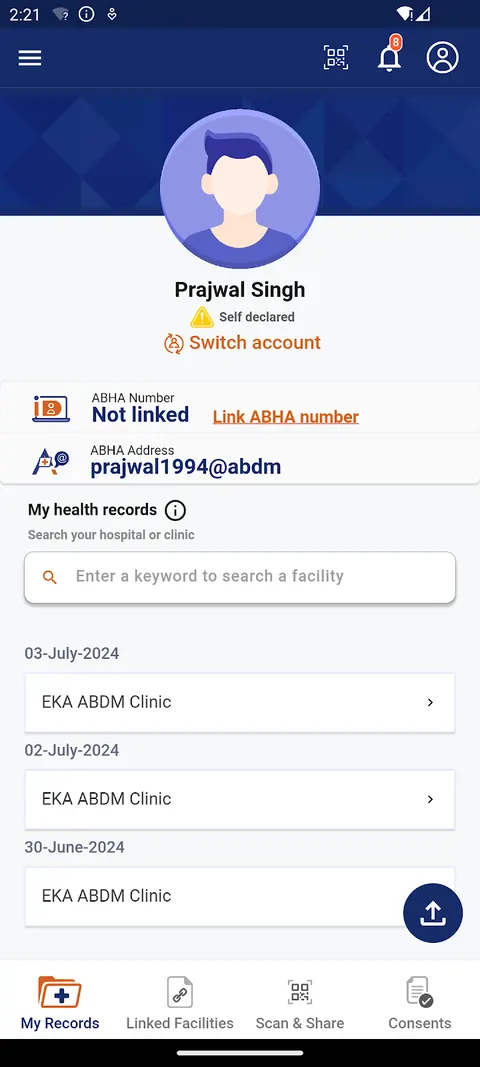
Records listed by date, with the facility name on each row.
Ayu
Ayu's Medical History: the list scrolls and the month strip follows.
Sharing with a doctor
The ABHA app is built around consent. Its listing says you control who can access your records, what type of information, and for how long, and its Consents screen shows requests and approvals. That is a strong design for sharing inside the ABDM network, and it is the official way. A facility asks, you approve, and the approval has limits.
Ayu works differently. You share one document with a link or a QR code that expires in 30 minutes. It is simple and it is outside the network. If your clinic uses Ayu, you can scan its QR code to book and to answer the doctor's pre-visit questions. That is not general-public booking.
Reminders and tracking
The ABHA app's listing does not mention medicine reminders or tracking. Ayu can set medicine reminders from a prescription. You can ask in chat to set reminders and pick which medicines. Tell Ayu your blood sugar and it shows a card to save the reading with a meal type. That is for blood sugar only. You can also ask Ayu to chart a value such as blood sugar or HbA1c over time, and there is a blood-sugar log.
Family
The ABHA app's home screenshot shows a "Switch account" link. Its listing does not say more about family use, so we could not confirm how family members are handled. Ayu is one person on the free app. Family profiles are the one paid plan, from ₹99 a month.
Hospital counters and OPD tokens
This is where the ABHA app is simply ahead. The listing says you can scan a facility's QR code at the counter for express registration, and its screenshots show a Token History screen for OPD tokens. Recent reviews praise it. Ayu does not do this.
Languages
The Play listing text still says the ABHA app is available in Hindi and English. The app itself says more: on our test phone on 3 October 2026 its "Select Language" screen listed at least ten languages (English, Hindi, Telugu, Gujarati, Bengali, Tamil, Marathi, Assamese, Punjabi and Odia), and the list may have continued. Ayu is available in 9 languages: English, Hindi, Marathi, Tamil, Telugu, Kannada, Malayalam, Bengali and Gujarati.
Opening the ABHA app for the first time
We installed the ABHA app on a Redmi Note 10 on 3 October 2026 and opened it without logging in. We typed no personal data. The swipe row below shows that first launch, then its language picker, then the six images from its Google Play listing. We did not log in to the ABHA app, so those six are the only logged-in screens here and they come from the listing.
The ABHA app, from first launch to the Play listing screens
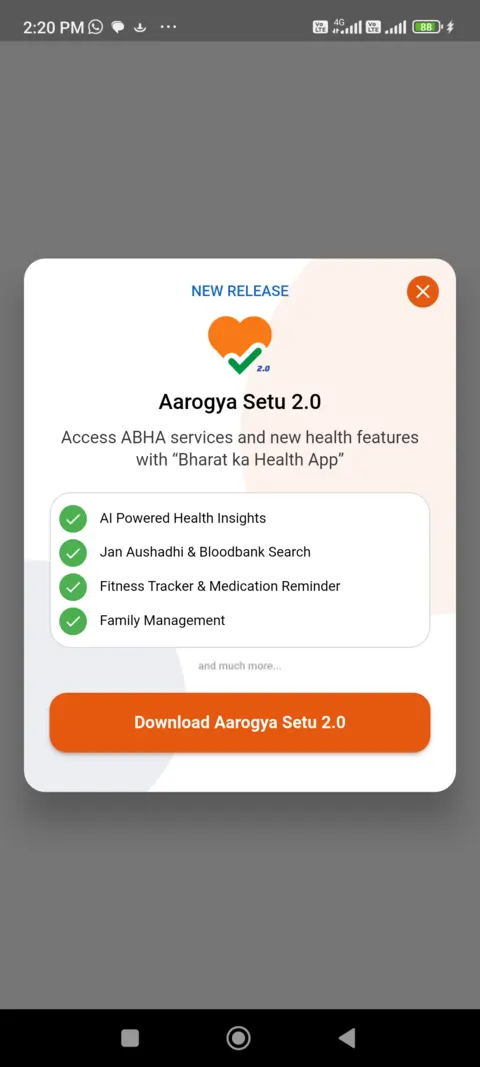
1 First launch
A card introducing Aarogya Setu 2.0, the newer National Health Authority app (our test phone)
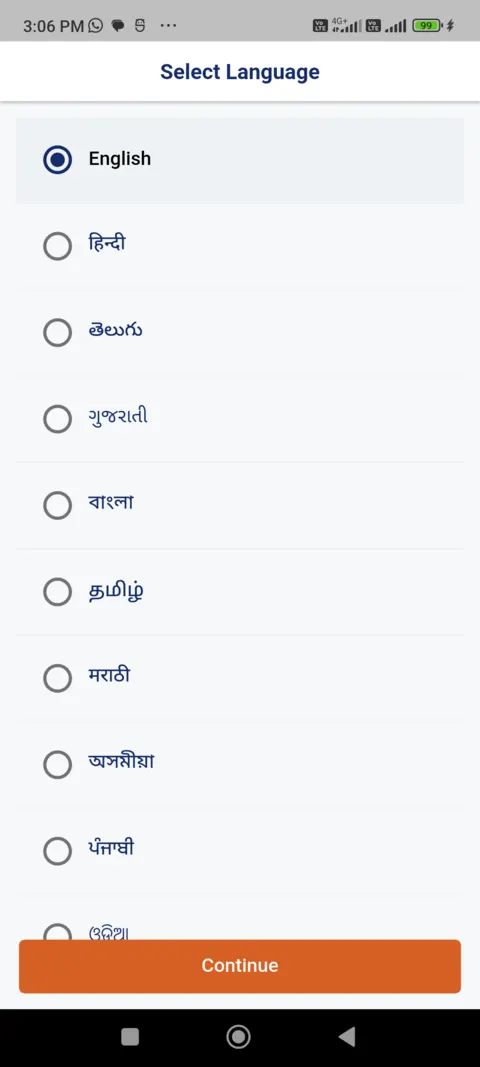
2 Language picker
Ten languages visible on our test phone; the list may continue
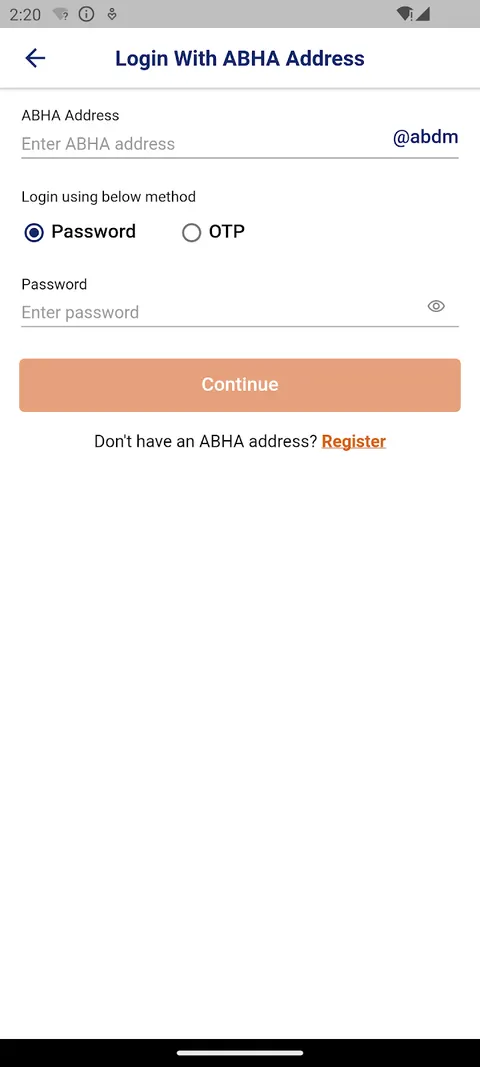
3 Login (from its Play listing)
Sign in with your ABHA address, by password or OTP
4 Home (from its Play listing)
ABHA address on top, then My health records by facility
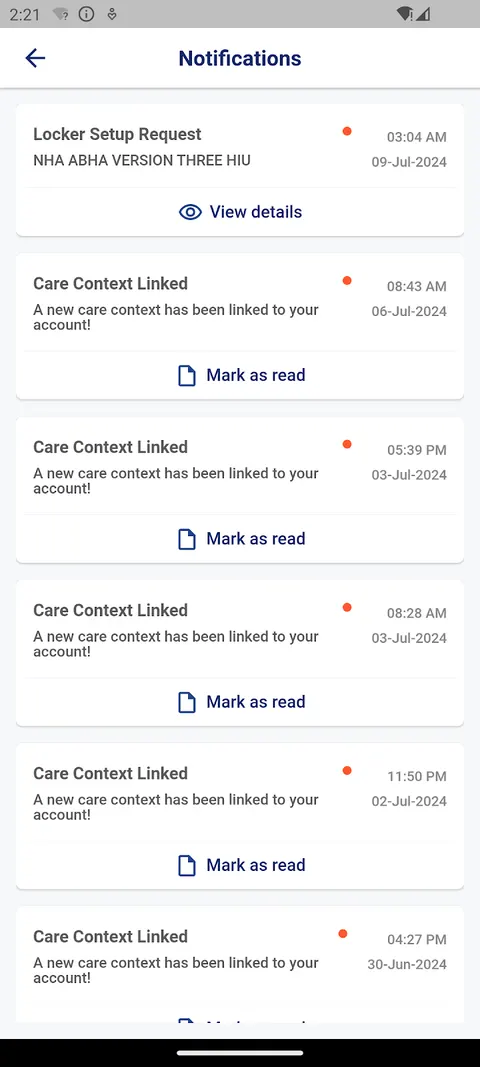
5 Notifications (from its Play listing)
A facility linked a new care context to the account
6 Linked Facilities (from its Play listing)
Facilities you have linked, and a button to add one
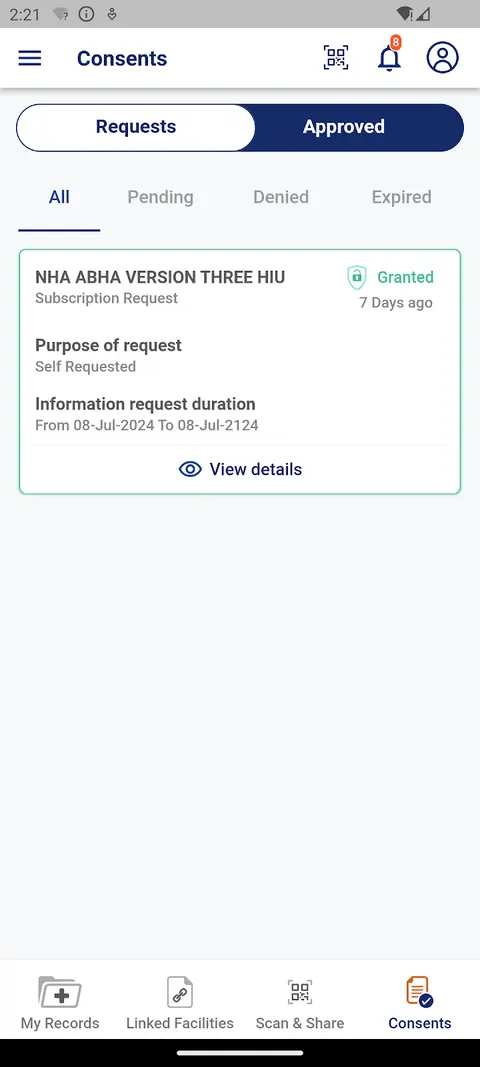
7 Consents (from its Play listing)
Requests, approvals and grant details
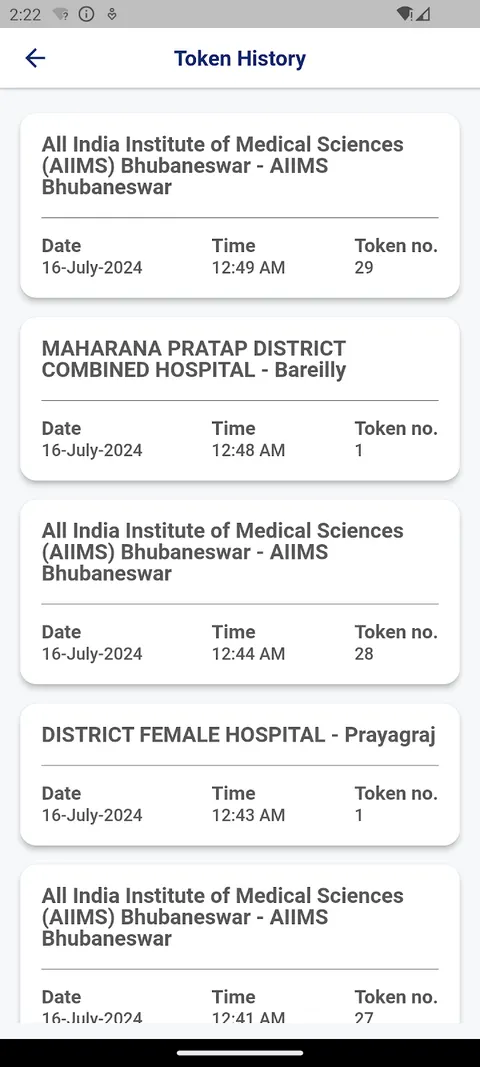
8 Token History (from its Play listing)
OPD tokens taken at hospitals
What we saw, in order:
- Before login, a "New release" card introducing Aarogya Setu 2.0, described on the card as "Bharat ka Health App", with a Download button. The card lists AI-powered health insights, Jan Aushadhi and blood bank search, a fitness tracker and medication reminder, and family management. Those are the card's own descriptions of the newer app, not something we tested.
- After login, per the listing images, a home screen that leads with your ABHA address and the status of your ABHA number, then a list of records by facility.
- The bottom bar in the listing image has four tabs: My Records, Linked Facilities, Scan and Share, and Consents.
The ABHA app now points you to Aarogya Setu 2.0, the National Health Authority's newer app, where ABHA services continue. People have used the ABHA app until now, and it remains the app described in this post. The ABDM page for the newer app says it is designed as a personal health record app powered by ABDM. We compare the two in Aarogya Setu vs the ABHA app.
We also opened Aarogya Setu 2.0 (version 3.1.6) on the same phone, logged in with an ABHA address but with no ABHA number linked. We saw no advertisements and no paid plan on the screens we reached. Its home screen has Consent Management, Upload Health Record, My Fitness Tracker, My Health Records, My Consents and a Government Programs block (PM-JAY and the CAPF scheme). Opening My Records, My Consents or My Profile took us to a "Link your ABHA Number" screen (Mobile OTP or Aadhaar OTP), so we did not see its records screens.

Aarogya Setu 2.0 on our test phone
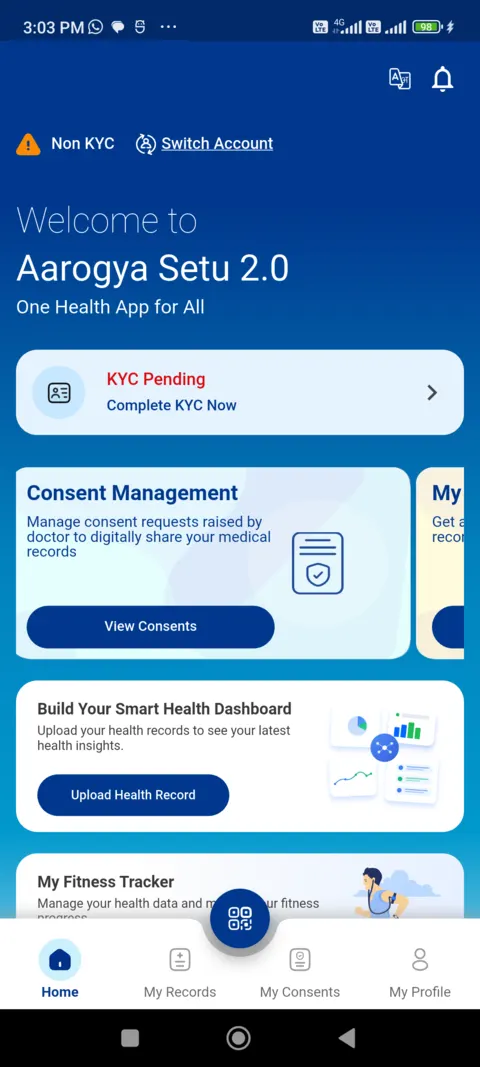
1 Home, top
KYC pending notice, Consent Management, Upload Health Record
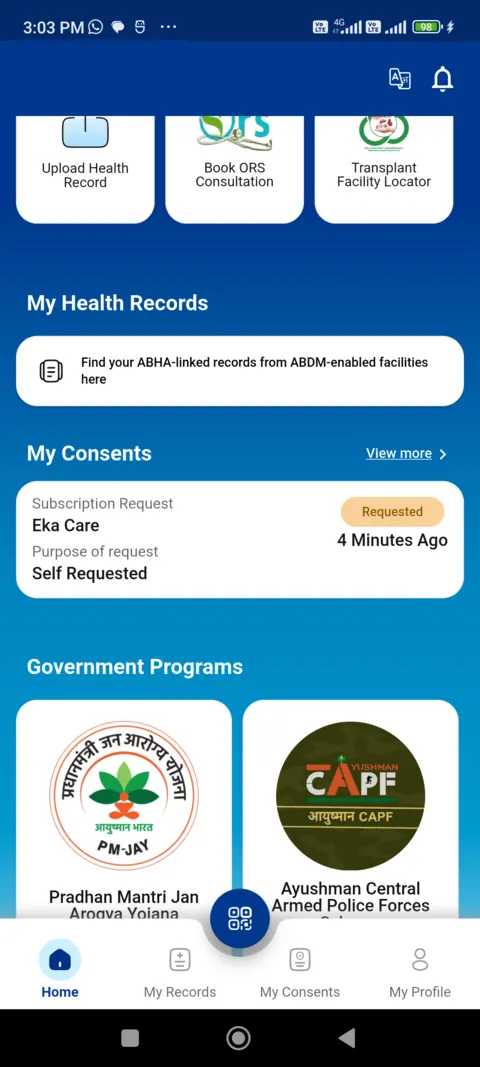
2 Home, scrolled
My Health Records, My Consents, Government Programs
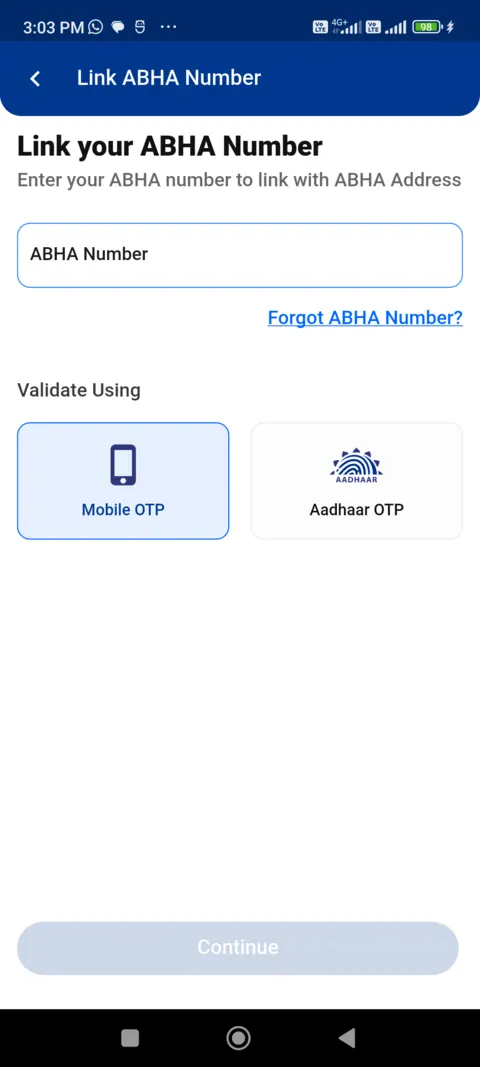
3 Link your ABHA Number
Where the records tabs led us without a linked ABHA number
Where paper records fit in
The ABHA app shows records from hospitals and labs on the ABDM network. A record arrives when a facility links it to your ABHA. Some of what families hold is not on the network yet:
- The handwritten prescription from your neighbourhood clinic.
- The PDF a small lab sent on WhatsApp.
- The discharge summary from five years ago.
- Anything from a provider that is not on ABDM yet.
Our ABHA explainer says the same thing: small clinics and standalone practitioners are often outside the network, so a large share of primary care does not add records to ABHA on its own. If you need to digitise what you already hold, start with how to digitise medical records.
We could not confirm from the ABHA app's listing whether you can upload your own documents into it, and it does not describe reading the contents of a document. Open the app and check before you rely on it for old paper records.
Side by side
| ABHA app | Ayu | |
|---|---|---|
| Who runs it | National Health Authority, Government of India | Ayu, a private company in India |
| What it is for | Your ABHA address, consent, and records from ABDM-linked facilities | Reading and organising the documents you hold |
| On Google Play since | 22 December 2020 | 16 March 2025 |
| ABHA | Yes. This is the official app for it | Not live as of 3 October 2026. Planned for November 2026 |
| Records from hospitals on ABDM | Yes, when the facility links them | No |
| Paper prescriptions and old reports | Could not confirm self-upload from its listing | Camera, gallery photos or PDF |
| Reads what is inside the document | Not mentioned | AI reads prescriptions, lab reports, scans, discharge summaries and bills, and sorts them by type, date and doctor |
| Medical history view | List of records by facility and date | Medical History timeline grouped by month, plus a Documents tab |
| Ask questions about your records | Not mentioned | Yes. Answers draw on your uploaded records and are not medical advice |
| Reminders | Not mentioned | Medicine reminders from a prescription |
| Sharing | Consent-based, with registered doctors and facilities | A link or QR code for a document that expires in 30 minutes |
| OPD token by QR at hospitals | Yes | No |
| App languages | At least 10 in its language picker on our test phone: English, Hindi, Telugu, Gujarati, Bengali, Tamil, Marathi, Assamese, Punjabi, Odia (its listing text says Hindi and English) | 9: English, Hindi, Marathi, Tamil, Telugu, Kannada, Malayalam, Bengali, Gujarati |
| Family | A "Switch account" link is visible; nothing else in its listing | One person on the free app. Family profiles are the one paid plan, from ₹99 a month |
| Price and ads | Free, no ads, no in-app purchases | Free to use. No ads, and none will be added. The only paid thing is the family plan, from ₹99 a month |
| Installs (Play) | 10 million+ | A newer, smaller app |
"Not mentioned" means we did not find it on the pages we read, not that the feature is missing.
What changes when ABHA comes to Ayu
Today you need the ABHA app for the ID and something else for your paper. We are building ABHA into Ayu so that one app does both. This is a plan, not a feature. The plan is for November 2026:
- Create an ABHA ID, or connect the one you have, inside Ayu. No second app to install for it.
- Your paper, digitised. Ayu already reads the prescriptions and reports you photograph and turns them into medicines, dates and doctors.
- On your phone and in the cloud. Records you have already opened stay on your phone and can be viewed without a connection; new uploads wait and send when you are back online. Chat and reading new documents need internet. Everything also sits on your account in the cloud.
- A new phone is not a fresh start. Sign in and your history is there.
- Records you can understand. Ask Ayu what a report says in plain language. It answers from your own records.
Until that ships, this is a plan. As of 3 October 2026 ABHA is not live in Ayu. We will update this page on the day it goes live. If you need an ABHA today, create it on the official ABHA portal or in the ABHA app.
Where the ABHA app is stronger
- It is the official source. Your ABHA address and consent settings live in the government's own system. Nothing sits between you and it.
- Free, no ads, no purchases.
- Hospital counters. OPD tokens and express registration by QR code at ABDM facilities. Ayu does not do this.
- Records arrive without you doing anything, when the hospital is on ABDM.
- Consent with limits. You choose who, what type and how long, and you can see requests and approvals.
- Scale. 10 million+ installs. Ayu is a newer, smaller app.
Where Ayu is stronger
- It works with the records you have today, whether or not the clinic is on ABDM.
- It reads the document. Medicines, timing, doctor and date are pulled out. Ayu's AI attempts handwritten as well as printed prescriptions; always check the extracted details against the original.
- A timeline, not a list of facilities. Records are grouped by month so the order of events is clear.
- You can ask. "What was my last thyroid result?" gets an answer from your records. It is not medical advice.
- Reminders and a sugar log that the ABHA app's listing does not mention.
- Nine app languages.
Privacy and your data
| ABHA app | Ayu | |
|---|---|---|
| Sharing | Its policy says user information is not shared with any third party unless required by law, and that records are not disclosed without your consent. Access by doctors is by your consent | AI features send data to AI providers, with your consent |
| Encryption | "Where appropriate, encryption methods are used to protect data" (its policy) | Encrypted in transit and at rest |
| Where data is stored | Not stated in the policy text we read | Google Cloud servers in Mumbai, India |
| Deleting your account | Through the account deletion feature on the official ABHA portal | From inside the app |
The ABHA policy text we read does not state where data is stored, so we cannot tell you. For Ayu, AI features send document content to an AI provider with your consent, which is the trade for having a document read. See medical record security in India for questions to ask any app.
What recent reviews say
We read a sample of Google Play reviews in India: the 40 newest (30 September to 2 October 2026) and 25 sorted by rating from 2022 to 2026. The newest ones are mostly one to three words, so the sample is thin on detail.
- Praise: skipping queues, a quick OPD token at government hospitals (about 12 of the 25 sorted reviews), a simple interface, saving time and helping elderly relatives. One wrote, "Best initiated to avoid queues to save time" (5 stars, 12 August 2026). Experiences vary by hospital, since the token and registration flow depends on the facility.
Real-life situations
An elderly parent with three specialists. Each doctor writes on paper. Unless all three hospitals are ABDM-linked, nothing arrives in ABHA. Ayu fits: photograph each prescription, and read the combined medicine list. Keep the ABHA app too if one hospital is on ABDM.
Someone tracking diabetes. Ayu lets you save a blood-sugar reading with the meal type and chart it. The ABHA app's listing does not mention tracking, and its value here is the lab reports a facility might send.
A government hospital OPD visit. Use the ABHA app. Scan the QR code at the counter for registration and the token, and a facility that is on ABDM can then link what it creates.
Switching phones. In the ABHA app your records live with the network, and you log in with your ABHA address. In Ayu, your records sit on your account in the cloud, so sign in on the new phone. Records you opened before stay viewable offline on the old phone; the new one fetches them again when online.
A second opinion. A new doctor wants the earlier reports. If the reports are with an ABDM facility, the consent flow can send them. If they are on paper, scan them in Ayu and share the one document by a 30-minute link or QR code.
Which should you use
- Standing at a government hospital counter: the ABHA app. Scan, get the token.
- A hospital asks for your ABHA: the ABHA app or the ABHA portal.
- A drawer of old prescriptions and lab reports: Ayu.
- A parent whose medicines nobody in the family can list: Ayu. Photograph the latest prescription and read the list.
- You want one app for everything: not possible today. Keep both until ABHA is live inside Ayu.
Related reading: PHR apps in India compared, which ABHA app to use, DRiefcase vs Ayu, Eka Care vs Ayu, the best app to store medical records, and how to digitise medical records.
Frequently Asked Questions
Common questions about the ABHA app and Ayu
Disclaimer
This comparison is written by the team that builds Ayu. Facts about the ABHA app come from its public Play Store listing, privacy policy and the app on our test phone on 3 October 2026, and may have changed since. The ABHA section about Ayu describes a planned feature that is not live. Nothing here is medical advice.