The short answer
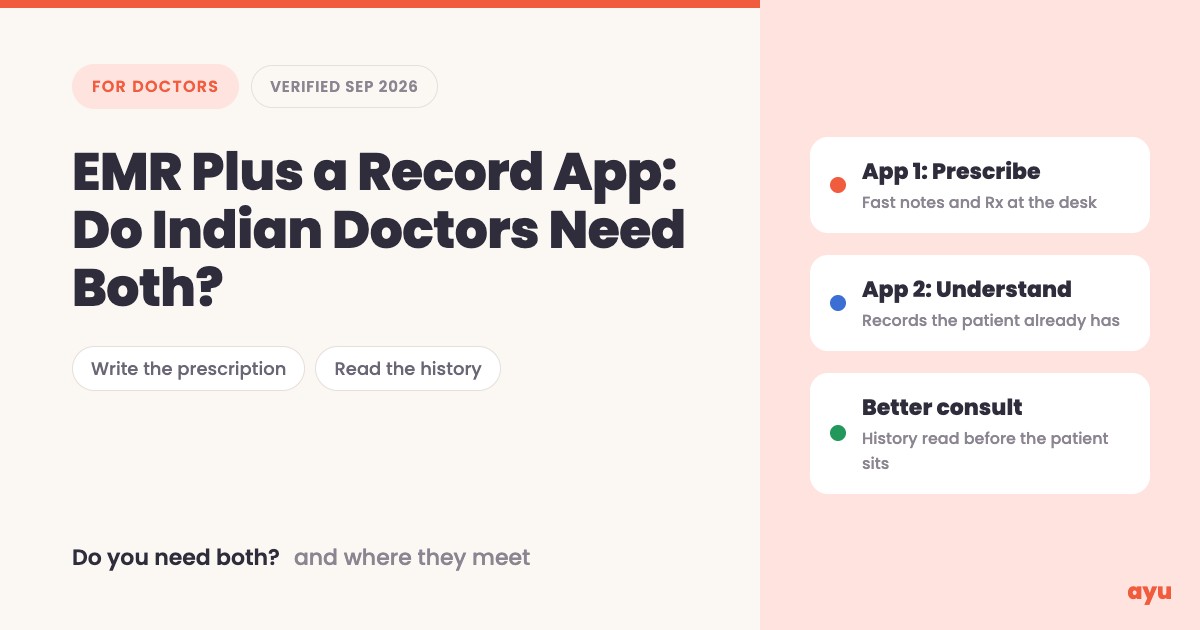
An EMR and a patient record app solve different problems, so plenty of Indian doctors run both. The EMR makes the encounter fast: writing, storing and sending the prescription. A record app makes the start of the encounter informed: it reads the paper, PDFs and photographs a patient brings and summarises them.
The twist: we build Ayu Doctor, and it now does both. It reads and summarises records, writes prescriptions with AI and takes notes from the consultation, in one app. So for some doctors the honest answer to "do I need both?" is "you need one, if it covers your workflow". This post covers when two apps still make sense and when one is enough. Last verified: September 2026.
The second app earns its place only if many of your patients arrive with history that never passed through your EMR. If nearly everyone you see has years of records inside your own system, you probably don't need a record app at all.
An illustrative scenario
The following is a composite illustration of a common pattern, not a named doctor or a measured case study.
Picture a cardiologist in a metro city who has used an AI-assisted EMR for years and would not give up its prescribing speed. A referred patient arrives with a plastic folder: a government hospital report from two years ago, a GP's handwritten prescription from six months back, a recent ECG printout and a private lab report. None of it is in the EMR.
Without a record layer, the doctor flips through the folder, tries to read the handwriting, asks the patient what she takes, and reconstructs the history aloud. With one, the daughter photographs the documents in the waiting room, the handwriting is converted to text, and the doctor starts the consultation from a structured summary of medications, flagged allergies and trends. The prescription still goes out through the EMR. The two tools do different jobs and do not conflict.
Why an EMR is the right tool for the encounter
HealthPlix is one example. Its website says it serves more than 14,000 doctors in India, and its NABH listing describes prescription generation from doctor-patient conversations in 11 languages. It is built around the friction of a busy OPD: limited time per patient, prescription formats and interaction checks.
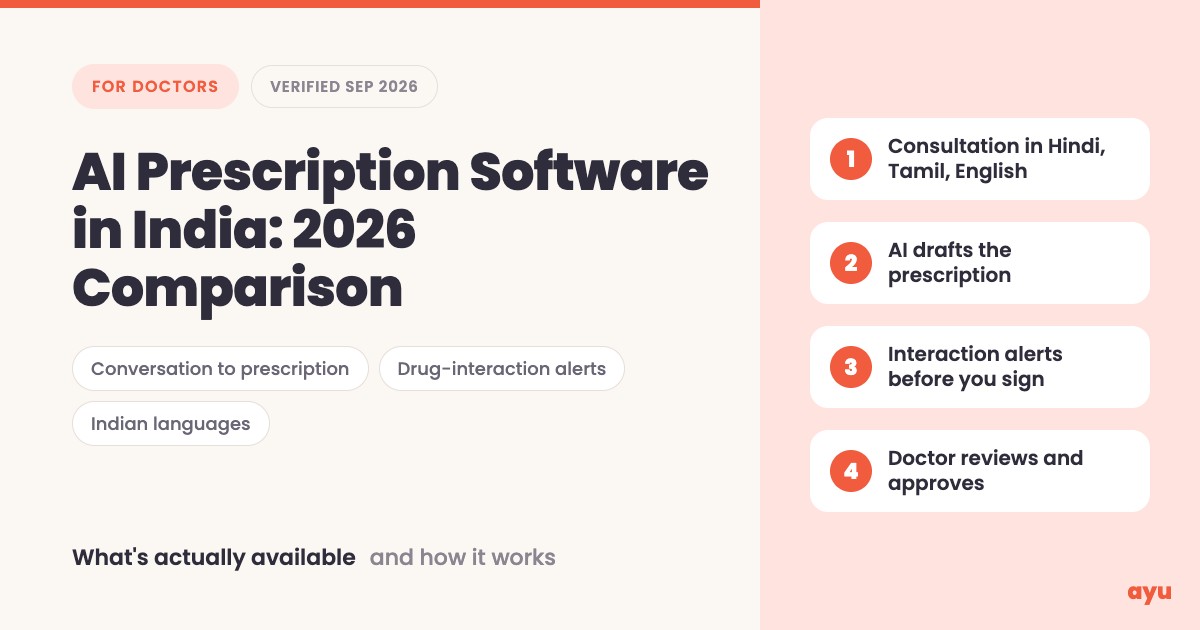
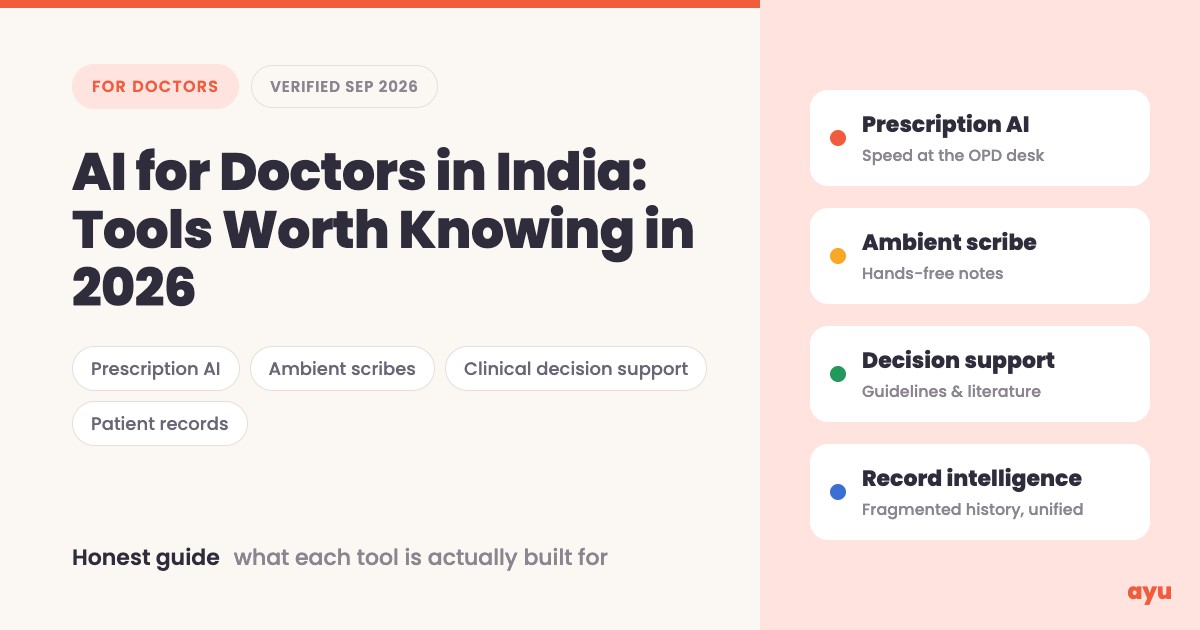
For writing prescriptions and running a clinic, an EMR is designed for the job. Our comparison of AI prescription tools in India covers what each option offers, and Clinical AI in India: What Works covers the wider landscape.
What an EMR was not designed to do
An EMR structures and retrieves the data that passes through it. It cannot read data that never did. In India, a great deal of history never has:
- handwritten prescriptions from smaller clinics and government hospitals
- physical lab reports from diagnostic centres without digital integration
- referral letters written on paper
- vaccination records in paper booklets
- reports from hospitals visited during travel or emergencies
The ICMR-INDIAB national study estimated 101 million people living with diabetes in India in 2021. Many such patients see a GP, an endocrinologist, an ophthalmologist and others in a single year, often at different institutions with no shared record. When this patient arrives, your EMR shows what they documented with you and nothing from elsewhere.
That is not a criticism of any EMR. It is a design boundary, and it is what the second app is for. Our piece on what paper records cost Indian clinics looks at the operational side.
What the workflow looks like
- Before the patient sits down, documents are uploaded to Ayu, by the patient, a family member or clinic staff, from photographs or PDFs.
- Ayu reads and structures them: handwriting OCR, a chronological timeline, and an AI summary of medications, trends and what the last specialist concluded.
- You read the summary, check anything that matters against the original document, and start the consultation with context.
- The prescription and notes can be written in the same app (Ayu Doctor does AI prescription writing and ambient notes), or you can keep them in your existing EMR and use Ayu only for the record side. Both setups work.
Because OCR and AI summaries can be wrong, treat the summary as a starting point and confirm doses, allergies and key values against the source.
Where Ayu Doctor fits: one app or two
Ayu Doctor started as a patient record intelligence layer. Think of it as what a careful medical secretary does when they prepare the full file before you see someone, automated for every patient. It now also writes prescriptions and takes consultation notes.
One app: if you want records, prescription and notes in one place, that's the simplest setup. It also means fewer clicks. By our own count a routine prescription takes about 4 clicks in Ayu Doctor versus about 40 in Eka Care. Count your own before you decide.
Two apps: if you're happy in an EMR you like and only want the record side, run Ayu next to it. Nothing about your EMR has to change.
Check before you switch: if you rely on your EMR for billing, scheduling or wider clinic management, confirm with the Ayu team what it covers for your setup before you move over.
Ayu Doctor is ₹4,999 per month, or ₹3,000 per month on a yearly plan, with unlimited patients (as of September 2026). It's a predictable monthly cost, not a per-patient one.
When the two-app workflow makes sense
- Your patients often come from outside your digital ecosystem. Referrals from government hospitals, smaller towns and other specialties.
- You follow chronic conditions over years. For diabetes, glaucoma or thyroid disease, the trend across visits can matter more than any single consultation.
- Patients share records as photographs. Reports photographed and passed around on WhatsApp are data your EMR cannot see.
- Your consultations often start with "what did the last doctor say?" If you spend clinical time reassembling history from paper, that time is the target.
When it adds little
If you run a single-specialty practice where nearly every patient has been with you for years and their records already live in your EMR, a second app adds limited value. Its usefulness scales with the gap between what your EMR holds and what exists in the patient's real history. For specialties with complex referral patterns, such as cardiology, nephrology, diabetology and ophthalmology, that gap is often large. For a GP with a stable panel it may be small. Judge your own case honestly.
How to test it without committing
Pick a week and use the record layer only for referred patients or those arriving with paper. Note how long you spend reconstructing history on those visits before and during the trial, and whether the summaries surface anything you would otherwise have missed. If the answer is no, you have your answer.
Frequently Asked Questions
Common questions about using an EMR and a patient record app together
Related reading
- AI for Doctors in India: Tools Worth Knowing in 2026
- AI Prescription Software in India: 2026 Comparison
- Complete patient history before a consultation
- eka.care vs Ayu
This article describes how some doctors structure their clinical software. It is not a product recommendation for any specific clinical situation, and Ayu Health is not affiliated with the third-party vendors named. Evaluate any software against your own practice before adopting it.