The short answer
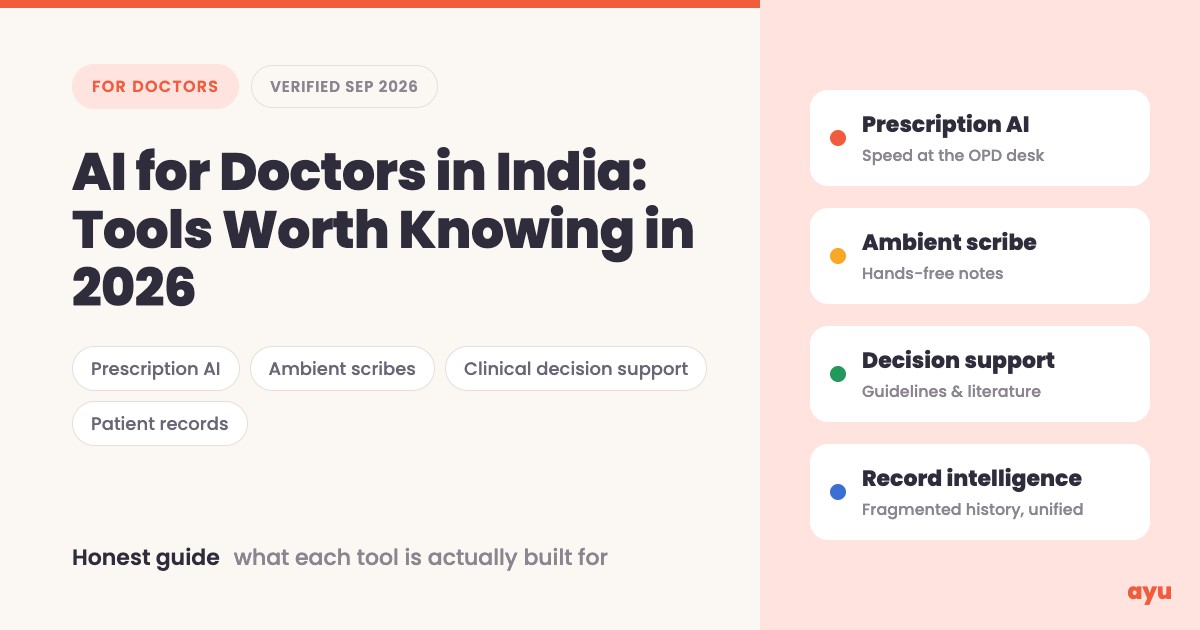
There is no single "best AI for doctors in India". In 2026 the tools doctors actually use do five different jobs, and each one fixes a different bottleneck:
- Writing prescriptions faster: AI-assisted EMRs like HealthPlix HALO.
- Hands-free notes: ambient scribes like EkaScribe.
- Making sense of a patient's history across clinics and paper: patient record intelligence like Ayu Doctor.
- Fast, cited answers to clinical questions: evidence search like Vera Health.
- Reading images: specialty imaging AI for retinal, chest X-ray and breast screening.
One thing up front: we build Ayu Doctor, so we're not neutral. It covers three of those jobs in one app: patient records, prescription writing and ambient documentation. We'll be straight about what every tool does and where it stops, so you can judge for yourself.
Pick the tool that kills your biggest daily bottleneck. Use it for a month. Then decide if you need a second one. Last verified: September 2026.
Why AI for doctors in India looks different from the West
Chatbots get the headlines. What earns a place in a busy Indian OPD is narrower: high patient volumes, consultations that flip between Hindi and English or a regional language, patients who walk in with a folder of paper reports, and a health system moving towards ABDM-linked records.
Below are the five categories. For each one: what it's built for, and where it stops. Feature and pricing details come from vendor pages and news coverage, so confirm with the vendor before you buy. Nothing here is clinical advice.
Category 1: AI for patient record intelligence, and more (Ayu Doctor)
Most tools in this guide work on what happens inside the consultation. Patient record intelligence works on what the patient already has before they sit down: photographed prescriptions, PDF lab reports, scanned referral letters, reports forwarded on WhatsApp.
That's where Ayu Doctor started. It turns those fragments into a structured, searchable timeline, reads handwritten prescriptions with OCR, and summarises the history into a pre-consultation brief: what the patient has been on, how key markers have trended, what the last specialist concluded.
It doesn't stop there. Ayu Doctor also writes prescriptions with AI and takes notes from the consultation itself (more under Categories 2 and 3). So the history, the prescription and the notes live in one app, not three.
Why one app matters: clicks. By our own count, a routine prescription that takes about 40 clicks in Eka Care takes about 4 in Ayu Doctor. Across a full OPD, that's the gap between finishing on time and typing into the evening. Don't take our word for it. Run one real patient through it and count.
Best for: doctors who want records, prescriptions and notes in one place. Also specialists who see a lot of referred patients (cardiology, endocrinology, nephrology, ophthalmology) and anyone managing chronic conditions where the trend across years matters more than any single visit.
Pricing: Ayu Doctor is ₹4,999 per month, or ₹3,000 per month on a yearly plan, with unlimited patients (as of September 2026). It's the doctor product, priced separately from the patient app.
If the underlying problem interests you, our guide on building a complete patient history before every consultation covers the clinical side, and what paper records cost an Indian clinic covers the operational side.
Category 2: AI for prescription writing (HealthPlix HALO)
HealthPlix is an AI-enabled EMR. Its website says more than 14,000 doctors in India use it, and its NABH listing describes automated prescription generation from doctor-patient conversations in 11 languages. HALO is the company's AI assistant layer.
The strongest published evidence for any tool in this guide is HealthPlix's drug-drug interaction (DDI) nudge. An observational study in the International Journal of Basic & Clinical Pharmacology looked at about 1.9 million patient visits on the platform and reported an average of 72,383 drug molecules removed after DDI nudges. Worth knowing: it's the vendor's own platform data, so it shows what happened after nudges appeared, not how many adverse events were prevented.
Best for: high-volume OPD doctors already inside the HealthPlix ecosystem, where prescription speed is the main constraint.
Pricing: varies by plan. Check the vendor's site for current rates.
Ayu Doctor does this too. Prescriptions are AI-assisted inside the same app where you're already reading the patient's history, so you're not switching tools mid-consultation. If you're already deep in an EMR you like, HALO is a fair choice. If you're choosing fresh, ask how many clicks it takes to get from "patient sits down" to "prescription printed", then count it in each app.
Category 3: AI for ambient documentation (EkaScribe)
EkaScribe is an ambient AI medical scribe from Eka Care, launched in September 2025 according to launch coverage. It runs on Eka's own model, Parrotlet, which the company describes as trained for Indian medical speech: Hindi-English code-switching, regional accents and Indian drug brand names. The vendor lists support for 20+ languages.
You don't type during the consultation. The scribe listens and produces a structured note or prescription-ready output at the end. Eka Care says it can run on its own or plug into existing EMRs. The vendor also reports that doctors save over 12 hours a week. Treat that as a vendor claim from its own users, not an independent measurement.
Best for: doctors who find typing disrupts the patient conversation, and those consulting mostly in regional languages.
Pricing: the vendor lists a limited free plan. Paid pricing varies by plan, so check the vendor's site.
Ayu Doctor does this too. It takes notes from the consultation in the same app that already holds the patient's history and writes the prescription. EkaScribe is a dedicated scribe built for a long language list. Ayu Doctor's pitch is different: notes, prescription and records in one place, and by our count about 4 clicks where Eka Care needs about 40 for a routine prescription. If you want a specialist scribe, look at EkaScribe. If you want one app, look at both and count the clicks.
Category 4: AI for clinical evidence queries (Vera Health)
Vera Health is a clinical search tool that returns cited answers from a large body of medical literature and guidelines. According to Vera's own materials, it was built by AI researchers with clinicians from institutions including Mayo Clinic and Yale. Access is free to licensed clinicians after professional verification, with no geographic restriction.
Vera's May 2026 blog post reports 84.9% on the NEJM-AI dataset and 97.5% on USMLE-style questions. That comparison is vendor-authored, and exam-style benchmarks aren't the same as reliability in your clinic. Use any tool like this as a cited starting point, then check the source it points to.
Best for: quick, referenced lookups between patients: dosing in renal impairment, guideline comparisons, interaction checks.
Category 5: AI for diagnostic imaging
Imaging AI is the most specialty-specific category and the most regulated. Examples: AI-assisted retinal screening on handheld fundus cameras (relevant to ophthalmology and diabetes care), chest X-ray reading tools used in TB screening, and Niramai's Thermalytix, a radiation-free thermal-imaging test for breast cancer screening that the company says has CDSCO clearance.
Before you adopt any imaging AI, verify its CDSCO status for your specific use case, ask for published validation on Indian patients, and confirm who reviews the output. These tools support a reporting clinician. They don't replace one.
Quick comparison
| Tool type | Example | What it works on | Best for | Pricing |
|---|---|---|---|---|
| All-in-one doctor app | Ayu Doctor | Patient records, consultation audio and prescriptions in one app | Doctors who want fewer apps and fewer clicks | ₹4,999/month, or ₹3,000/month on a yearly plan; unlimited patients |
| AI-assisted EMR | HealthPlix HALO | Consultations recorded inside HealthPlix | High-volume OPD prescribing | Varies by plan; check vendor |
| Ambient scribe | EkaScribe | Live consultation audio | Voice-first documentation, regional languages | Varies by plan; check vendor |
| Evidence search | Vera Health | Published literature and guidelines | Cited clinical Q&A | Vendor lists free access for verified clinicians |
| Imaging AI | Retinal, chest X-ray, thermal breast screening | Images from specific devices | Screening programmes, radiology and ophthalmology | Device and service pricing varies |
Last verified: September 2026. Vendor facts change quickly, so confirm before you decide.
Which AI tool fits your situation
These aren't strict competitors. They solve different problems, so the useful question is which bottleneck costs you the most time today.
- "I'm tired of switching between apps." Look at an all-in-one like Ayu Doctor, where records, prescription and notes sit together. Count the clicks against what you use now.
- "Documentation takes too long." Start with HALO if you're already on HealthPlix, or a dedicated ambient scribe such as EkaScribe if you want a voice-first workflow that sits alongside an EMR.
- "I keep rebuilding history from paper at the start of every consultation." That's what patient record intelligence is for. Try Ayu Doctor on your next referred patient.
- "I need a referenced answer mid-clinic." Use an evidence search tool and verify the cited source.
- "I do retinal, chest or breast screening." Look at specialty imaging AI, and check regulatory status first.
- "Can I just use ChatGPT?" For administrative writing, sure. For patient-identifiable data, think about your obligations under the DPDP Act, 2023. And don't lean on a general chatbot for clinical decisions.
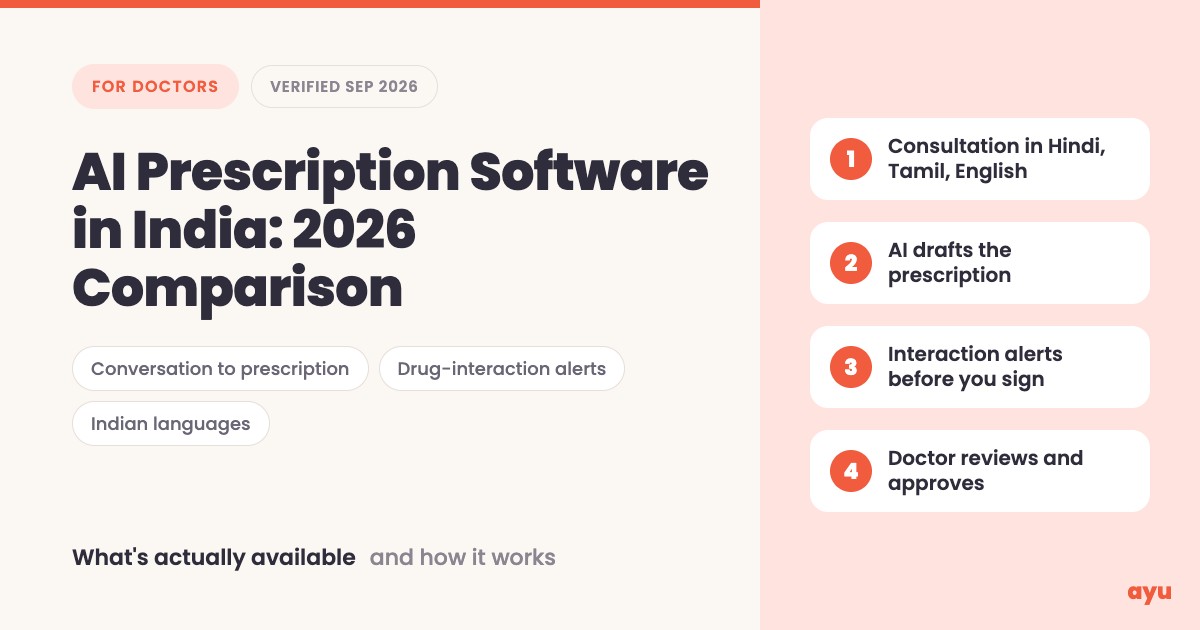
Plenty of doctors stitch two or three tools together: an EMR for prescriptions, a scribe for notes, a folder of old reports. Every hand-off costs clicks. That's the case for one app. Some doctors still prefer a specialist tool for each job, and that's a fair call. We lay out the trade-off in EMR Plus a Record App: Do Indian Doctors Need Both?, and compare the prescription-side options in AI Prescription Software in India: 2026 Comparison. For a wider view of adoption and pitfalls, see Clinical AI in India: What Works.
What none of these tools can do yet
Cross-platform patient identity. No tool reliably knows that "Ramesh Kumar" in one EMR and "R. Kumar" on a lab report are the same person without confirmation. ABHA IDs are meant to help, but adoption is uneven, so record aggregation still needs a human check. Our explainer on UHID, ABHA and other hospital ID types shows why.
Up-to-the-minute drug information. Drug databases inside tools update periodically. For newly approved drugs or recent guideline changes, check the prescribing information.
Complex, multi-system reasoning. A patient with several comorbidities, multiple specialists and social factors affecting treatment still needs your judgment. Published reviews of AI decision support point to human oversight, transparency and governance as the main requirements. These tools extend your capacity. They don't replace it.
Why patient record tools matter in India
India's diabetes burden is large: the ICMR-INDIAB national study estimated 101 million people living with diabetes in 2021. Patients with chronic conditions often see a GP, a specialist and a diagnostic lab in the same year, frequently at different institutions with no shared record. That fragmentation is the gap patient record intelligence tries to close.
Frequently Asked Questions
Common questions about AI tools for Indian doctors
Related reading
- AI Prescription Software in India: 2026 Comparison
- EMR Plus a Record App: Do Indian Doctors Need Both?
- Clinical AI in India: What Works
- eka.care vs Ayu
This guide reflects publicly available information as of September 2026, plus Ayu's own product details. It is for information only, is not a product endorsement or clinical advice, and Ayu Health is not affiliated with the third-party vendors named. Verify features, pricing and regulatory status directly with each vendor before adoption.