The short answer
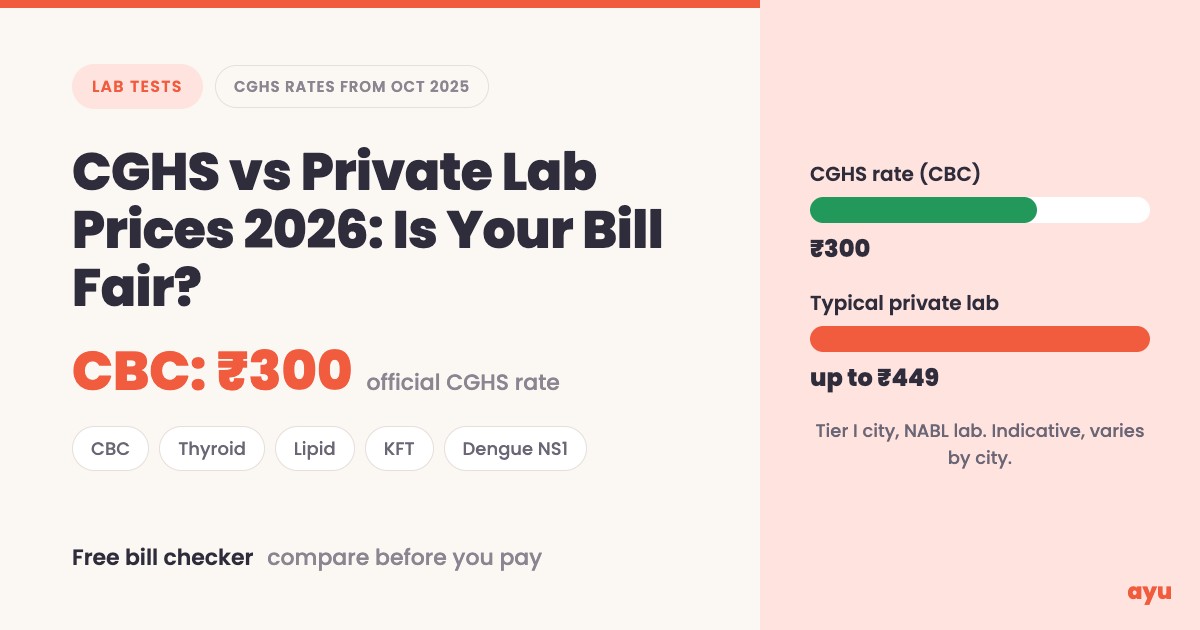
From 13 October 2025, CGHS pays empanelled labs fixed rates such as ₹300 for a CBC, ₹200 for TSH, ₹300 for HbA1c and ₹490 for a lipid profile in a Tier I city at an NABL-accredited lab. These rates apply to CGHS beneficiaries, not to everyone, but they are a useful yardstick for judging a private lab bill.
Key Takeaways:
- The current official CGHS rate list is the Directorate General of CGHS office memorandum dated 3 October 2025, effective 13 October 2025. We read the rates directly from it on 21 September 2026.
- CGHS rates depend on the city tier and the lab. Tier II cities are 10% lower, Tier III cities 20% lower, and labs without NABL accreditation are paid 15% less. The numbers in this article are for Tier I cities and NABL-accredited labs.
- CGHS rates are for CGHS beneficiaries at empanelled labs. They are not what a government hospital charges the public, and they are not a legal price cap for other customers.
- For many tests, typical private lab prices bracket the CGHS rate. For small-ticket tests such as blood glucose and creatinine, retail private prices often run above it.
- Older single-test guides on this site quote lower CGHS figures for some tests. The figures in this article, taken from the October 2025 document, replace them.
Check Your Bill in 30 Seconds
Pick the test, type the price you were quoted, and the checker shows where it falls against the CGHS rate and the typical private lab range.
CGHS Rates vs Private Lab Prices: The Comparison Table
The CGHS column shows the rate for a Tier I city, NABL-accredited lab, taken from Annexure I of the 3 October 2025 memorandum. The private column shows the indicative ranges published in our single-test price guides (CBC and creatinine come from our August 2026 seven-lab price check; the rest from the per-test cost guides). Private prices vary by city, lab and offer, so treat them as a guide and not a promise.
Who can use the CGHS rate: only CGHS beneficiaries, at CGHS-empanelled labs. Everyone else pays the lab's own price, which is what the private column describes.
| Test | CGHS rate (Tier I, NABL lab) | Typical private lab range | Where the CGHS rate sits |
|---|---|---|---|
| CBC / complete haemogram | ₹300 | ₹250 to ₹449 | Inside the private range, lower half |
| TSH | ₹200 | ₹150 to ₹600 | Inside the range, near the bottom |
| Thyroid profile (T3 + T4 + TSH) | ₹450 | ₹400 to ₹900 | Inside the range, near the bottom |
| Free T3 or Free T4 (each) | ₹125 | ₹200 to ₹500 | Below the private range |
| Blood glucose: fasting, post-meal or random (each) | ₹40 | ₹50 to ₹200 | Below the private range |
| HbA1c | ₹300 | ₹250 to ₹600 | Inside the range, near the bottom |
| Lipid profile | ₹490 | ₹300 to ₹900 | Inside the range, lower half |
| Serum creatinine | ₹100 | ₹139 to ₹309 | Below the private range |
| Kidney function test (KFT) | ₹500 | ₹350 to ₹900 | Inside the range, lower half |
| Liver function test (LFT) | ₹500 | ₹350 to ₹950 | Inside the range, lower half |
| Dengue NS1 antigen | ₹400 | ₹400 to ₹900 | At the bottom of the private range |
| Vitamin D (25-OH) | ₹1,000 | ₹400 to ₹1,500 | Inside the range, upper half |
| Vitamin B12 | ₹600 | ₹400 to ₹1,600 | Inside the range, lower half |
| Serum ferritin | ₹350 | ₹300 to ₹1,200 | Inside the range, near the bottom |
A few details behind the numbers:
- CBC: the CGHS rate of ₹300 is for the full package (haemoglobin, RBC count and indices, total and differential counts, platelets, ESR and peripheral smear). Non-NABL labs are paid ₹255.
- KFT: the CGHS KFT package covers serum creatinine, blood urea, BUN, uric acid, sodium, potassium and a urine routine examination. Bought separately, the same document lists urea or BUN at ₹100 and uric acid at ₹150.
- Thyroid: the same document lists TSH alone at ₹200 and the T3 + T4 + TSH package at ₹450. It has no separate line for total T3 or total T4.
- Blood glucose: one rate (₹40) covers fasting, post-meal or random glucose. Each is a separate test if you need more than one.
- Vitamin D and B12: these are the two tests where the CGHS rate is higher than the price of many budget online listings. Our guides quote budget-lab prices of roughly ₹400 to ₹700 for vitamin D and ₹400 to ₹600 for B12.
If you are in a Tier II city such as Chandigarh, Surat, Patna or Kochi, the CGHS figures are about 10% lower (multiply by roughly 0.9). In a Tier III city they are about 20% lower (roughly 0.8). The eight Tier I cities in the document are Delhi, Mumbai, Bengaluru, Chennai, Kolkata, Hyderabad, Ahmedabad and Pune.
Lab by Lab: Dr Lal PathLabs vs Metropolis vs Apollo 24|7
Same test, three big names, three different prices. We read what each lab shows on its own website (August and September 2026) and lined the numbers up against the official CGHS rate. The lowest price in each row is highlighted. A dash means we couldn't verify that price, so we left it out.
Price by lab, 12 common tests
Checked August and 21 September 2026 · Dr Lal PathLabs and Metropolis: Mumbai. Apollo 24|7: pan-India base rate · prices change, confirm at checkout
| Test | CGHS rate |  Dr Lal PathLabs Dr Lal PathLabs |  Metropolis Healthcare Metropolis Healthcare |  Apollo 24|7 Apollo 24|7 |
|---|---|---|---|---|
| CBC (complete blood count)Checked Aug 2026 | ₹300 | ₹250 | ₹340 | ₹449 |
| Serum creatinineChecked Aug 2026 | ₹100 | ₹220 | ₹270 | ₹309 |
| Lipid profileChecked Aug 2026 | ₹490 | ₹830 | ₹800 | ₹919 |
| TSHChecked 21 Sep 2026 | ₹200 | ₹440 | ₹400 | ₹399 |
| Thyroid profile (T3 + T4 + TSH)Checked 21 Sep 2026 | ₹450 | ₹540 | ₹600 | ₹779 |
| HbA1cChecked 21 Sep 2026 | ₹300 | ₹540 | ₹640 | ₹689 |
| Fasting blood glucoseChecked 21 Sep 2026 | ₹40 | ₹85 | — | ₹109 |
| Liver function test (LFT)Checked 21 Sep 2026 | ₹500 | ₹790 | — | ₹919 |
| Dengue NS1 antigenChecked 21 Sep 2026Lal's price is the EIA method; Metropolis does not state a method. | ₹400 | ₹600 | ₹800 | — |
| Vitamin D (25-OH)Checked 21 Sep 2026 | ₹1,000 | ₹1,480 | ₹1,800 | ₹2,149 |
| Vitamin B12Checked 21 Sep 2026 | ₹600 | ₹1,180 | ₹1,250 | ₹1,579 |
| Serum ferritinChecked 21 Sep 2026 | ₹350 | ₹650 | — | ₹1,069 |
CBC (complete blood count)
CGHS ₹300
- Lowest₹250
- ₹340
- ₹449
Checked Aug 2026.
Serum creatinine
CGHS ₹100
- Lowest₹220
- ₹270
- ₹309
Checked Aug 2026.
Lipid profile
CGHS ₹490
- ₹830
- Lowest₹800
- ₹919
Checked Aug 2026.
TSH
CGHS ₹200
- ₹440
- ₹400
- Lowest₹399
Checked 21 Sep 2026.
Thyroid profile (T3 + T4 + TSH)
CGHS ₹450
- Lowest₹540
- ₹600
- ₹779
Checked 21 Sep 2026.
HbA1c
CGHS ₹300
- Lowest₹540
- ₹640
- ₹689
Checked 21 Sep 2026.
Fasting blood glucose
CGHS ₹40
- Lowest₹85
- —
- ₹109
Checked 21 Sep 2026.
Liver function test (LFT)
CGHS ₹500
- Lowest₹790
- —
- ₹919
Checked 21 Sep 2026.
Dengue NS1 antigen
CGHS ₹400
- Lowest₹600
- ₹800
- —
Checked 21 Sep 2026. Lal's price is the EIA method; Metropolis does not state a method.
Vitamin D (25-OH)
CGHS ₹1,000
- Lowest₹1,480
- ₹1,800
- ₹2,149
Checked 21 Sep 2026.
Vitamin B12
CGHS ₹600
- Lowest₹1,180
- ₹1,250
- ₹1,579
Checked 21 Sep 2026.
Serum ferritin
CGHS ₹350
- Lowest₹650
- —
- ₹1,069
Checked 21 Sep 2026.
Prices read from each lab's own website on the date shown; a dash means we did not verify that price. Lab names and logos belong to their owners and are shown only to identify the price source. Ayu is not affiliated with these labs.
What stands out:
- Dr Lal PathLabs was cheapest in 10 of the 12 rows. Four of those rows have only two labs we could verify, so treat them as a partial picture.
- Metropolis was cheapest on lipid profile (₹800). Apollo 24|7 was cheapest on TSH, by ₹1 (₹399 against Metropolis's ₹400).
- Almost everything sits above the CGHS rate. The only exception in this table is Dr Lal PathLabs's ₹250 CBC, which is below the ₹300 CGHS rate.
- Some gaps are big. Vitamin B12 is ₹1,180 to ₹1,579 against a CGHS rate of ₹600. Ferritin is ₹650 to ₹1,069 against ₹350.
- No lab wins everywhere, and the ranking flips test by test. Check the specific test before you book.
Parameter counts, home-collection charges and discounts differ from lab to lab, so a lower price isn't always like-for-like. Apollo shows a pan-India base price and often displays a large "MRP" with a discount, so compare selling prices, not MRPs. Use these numbers as a yardstick, then ask what the quote includes. For the full breakdown on individual tests, see our guides on CBC, creatinine and lipid profile.
Why CGHS Rates Are Not a Price Cap for Everyone
CGHS stands for the Central Government Health Scheme. Its own portal describes it as serving Central Government employees and pensioners enrolled under the scheme, along with other notified categories. The October 2025 memorandum sets the rates that CGHS pays or reimburses at empanelled healthcare organisations and for medical reimbursement claims of beneficiaries.
Three points follow from that:
- You need to be a CGHS beneficiary. Enrolment is through the scheme, and the rates are applied at CGHS-empanelled labs and hospitals.
- The document does not fix a price for other customers. We found nothing in it that obliges a lab to charge a walk-in patient the CGHS rate. A private lab is free to set its own price for you.
- The rate depends on the lab. A non-NABL lab is paid 15% less than an NABL lab for the same test, and the city tier changes the figure again.
So why use CGHS rates at all if you are not a beneficiary? Because they are the one published, government-set benchmark for these tests. If a lab quotes several times the CGHS rate, that is a prompt to ask questions and compare, not proof of overcharging.
What About Government Hospital Prices?
Many people searching for a blood test price in a government hospital actually want the cost for an ordinary patient with no CGHS card. That is a different thing from the CGHS rate.
- There is no single national price list for what government hospitals charge the public that we could find. User charges are set by each state and often by each institution, and they change.
- Free testing is a stated policy goal. The National Health Mission runs a Free Drugs and Diagnostics Service Initiative, with guidelines shared with states in July 2015. It aims to give essential diagnostic packages free at each level of public facility, from sub-centres to district hospitals. What is actually free on a given day depends on the state, the facility and whether the machines and reagents are available.
- Some schemes cover tests for their own members. For example, ESI hospitals serve ESI beneficiaries. Ayushman Bharat PM-JAY is built around hospitalisation, so it does not typically pay for routine outpatient tests.
Our single-test guides list typical government-hospital ranges for each test, but those are indicative and vary a lot by state. For the current price of a specific test, ask the hospital's lab counter or check the hospital's website.
How to Tell Whether a Lab Bill Is Fair
You do not need to be a billing expert. Work through these steps:
- Get the exact test name. "Thyroid test" could mean TSH alone, a T3 + T4 + TSH profile, or a profile with antibodies. Prices differ several times over.
- Compare with the table above. Use the checker near the top of this page. A price near or below the CGHS rate is rarely a concern. A price well above the top of the private range deserves a question.
- Check what is included. Even the "same" CBC can carry a different number of parameters. In our August 2026 CBC check, panels ran from roughly 24 to 30 parameters, so a slightly higher price is not automatically a bad deal. See our CBC price comparison.
- Ask for an itemised bill. Look for add-ons: home collection, urgent or same-day processing, sample transport, report printing, or a hospital overhead.
- Check accreditation. NABL stands for the National Accreditation Board for Testing and Calibration Laboratories. CGHS itself pays non-NABL labs 15% less, which tells you how it values the difference.
- Compare two or three other labs. For a test that is not urgent, a few minutes of comparison usually saves more than the test's whole CGHS rate.
Practical Tips to Pay Less Without Cutting Corners
Packages versus individual tests. A health package is good value only if your doctor wants most of the tests in it. If you need one or two tests, price them individually and compare with the package price. Do not add tests you have not been advised to take. Our preventive health checkup guide explains which tests make sense at each age.
Ask about home collection. Some labs include it, others charge a fee. Our preventive checkup guide notes the fee ranges from nothing to about ₹100 to ₹200 at some labs. If you can visit the collection centre, ask whether the price changes.
Watch for hospital-attached labs. They are convenient during a stay, but standalone or accredited diagnostic labs are often cheaper for outpatient tests, according to our single-test guides.
Ask whether a recent report is enough. If you tested something a few weeks ago, ask your doctor whether repeating it is needed. Keeping past reports handy helps here. If you want them in one place, a personal health record app, such as the ones compared in our best PHR apps guide, can store your reports (Ayu lets you keep them in the app) so you can show a recent result instead of paying for a repeat.
Use the right test for the question. For example, if you are being monitored for diabetes, HbA1c and a fasting glucose answer different questions, and your doctor will say which you need.
Older CGHS Figures You May See Elsewhere
CGHS rates were revised with effect from 13 October 2025, replacing all previous memoranda on the subject. Some of our earlier single-test guides quote older, lower CGHS figures for a few tests. For example, they list CBC at ₹80 to ₹120, KFT at ₹200 to ₹350, lipid profile at ₹150 to ₹250, and LFT at ₹200 to ₹350. Those numbers do not match the current official document, which lists ₹300, ₹500, ₹490 and ₹500 respectively for a Tier I city at an NABL lab. If you see different CGHS figures on a website, check the date and compare with the Annexure I list in the October 2025 memorandum.
Test-by-Test Guides With Full Price Comparisons
This article is the overview. For more detail on individual tests, including what each test measures and how to read the result, use these guides:
- CBC price and what it measures and the CBC 7-lab comparison with anaemia checker
- Thyroid test price: TSH, T3 and T4
- Kidney function test (KFT) price and the creatinine price comparison with eGFR calculator
- Lipid profile price
- Blood sugar test price: FBS, PPBS and HbA1c
- Liver function test (LFT) price
- Dengue test price: NS1, IgM and IgG
- Vitamin D deficiency and testing and Vitamin B12 deficiency and testing
People Also Ask
Common questions about CGHS lab rates and private lab prices in India
Bottom Line
CGHS rates are the only official, published price yardstick for common lab tests in India, and they are worth knowing even if you never hold a CGHS card. Use them alongside the typical private range, the exact test name and what is included, and you will spot an unusually high bill quickly.
Medical Disclaimer
This article is for general information and does not replace advice from a doctor. CGHS rates are taken from an official document dated 3 October 2025 and may be revised. Private lab prices are indicative, vary by city, lab and offer, and may have changed since they were checked. Confirm the price with the lab before booking. Your doctor decides which tests you need.