The short answer
On 27 September 2026 the price shown for a dengue NS1 antigen test by ELISA or similar at six large Indian labs ran from ₹588 (Redcliffe, Mumbai) to ₹800 (Metropolis, Mumbai). IgM antibody tests were ₹599 to ₹879, and IgG ₹595 to ₹960. The official CGHS rate is ₹400 for NS1 and ₹800 for IgM and IgG together, at an accredited lab in a Tier I city.
Free testing is narrower than most articles say. The central programme pays for IgM MAC-ELISA kits at sentinel surveillance hospitals. We found no official text that makes NS1 free everywhere, and no published government-hospital price for any dengue test.
Updated 27 September 2026. We re-read every lab page, the CGHS rate list, and the national dengue guideline. Older figures on this page (rapid NS1 at ₹200 to ₹500, "over 600 sentinel labs", a platelet-count action table, "no vaccine approved") were wrong, unsourced or out of date and have been removed.
Key facts about dengue testing in India
| Parameter | Detail |
|---|---|
| NS1 antigen (ELISA, EIA or immunoassay), six labs, Mumbai | ₹588 to ₹800 |
| Dengue IgM antibody (ELISA or EIA) | ₹599 to ₹879 |
| Dengue IgG antibody (ELISA or EIA) | ₹595 to ₹960 |
| IgM + IgG together (ELISA or EIA) | ₹1,198 to ₹1,770 |
| Rapid NS1 (cheapest we could verify) | ₹605 (Healthians); Apollo ₹1,039 |
| PCR | ₹3,850 (Metropolis) to ₹3,900 (Apollo) |
| Official CGHS rate, Tier I, accredited lab | NS1 ₹400; IgM and IgG ₹800 |
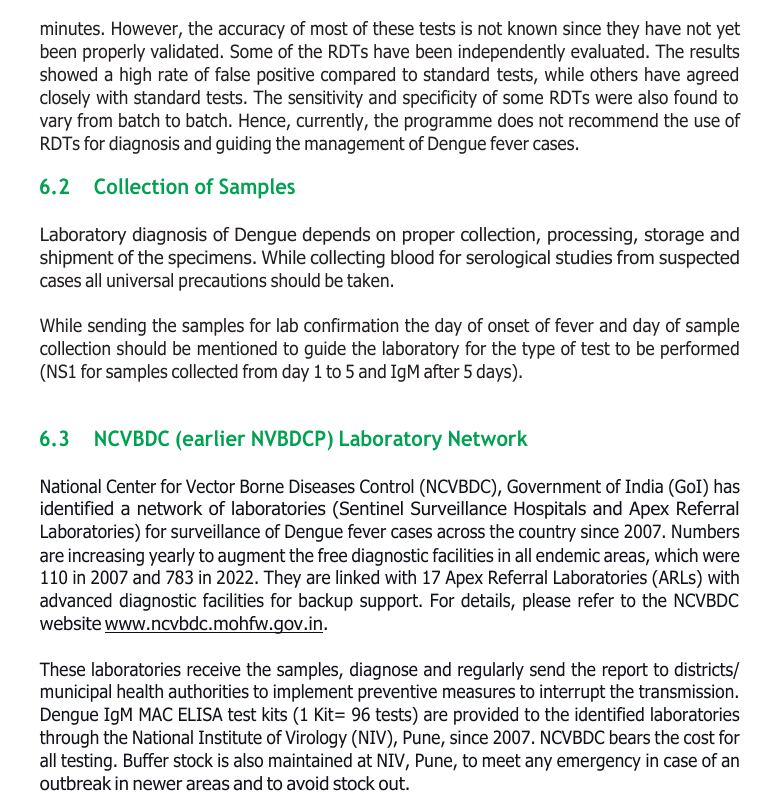
| National guidance on timing | NS1 for days 1 to 5 of fever, IgM after 5 days |
| Dengue cases reported in India | 121,824 in 2025 (West Bengal not reported); 233,519 in 2024 |
Dengue test price today, lab by lab
We opened each lab's own test page on 27 September 2026 and read the price it showed. Dr Lal PathLabs, Metropolis, Tata 1mg, Redcliffe and Healthians were on their Mumbai pages. Apollo 24|7 shows a pan-India base price (₹759 for the NS1 ELISA) and a Mumbai page at ₹709. Prices are what the page displays, not what a cart may charge after coupons or slot fees.
Dengue test price by lab
Checked 27 September 2026 · Dr Lal PathLabs and Metropolis: Mumbai. Apollo 24|7: pan-India base rate · prices change, confirm at checkout
| Test | CGHS rate |  Dr Lal PathLabs |  Metropolis Healthcare |  Apollo 24|7 |
|---|---|---|---|---|
| Dengue NS1 antigen (ELISA or EIA)Apollo's Mumbai page shows ₹709. Metropolis does not state a method. | ₹400 | ₹600 | ₹800 | ₹759 |
| Dengue IgM antibody | — | ₹600 | ₹800 | ₹879 |
| Dengue IgG antibody | — | ₹600 | ₹960 | ₹800 |
| Dengue IgM and IgG togetherMetropolis sells IgM and IgG only as separate tests. | ₹800 | ₹1,770 | — | ₹1,649 |
Dengue NS1 antigen (ELISA or EIA)
CGHS ₹400
- Lowest₹600
- ₹800
- ₹759
Apollo's Mumbai page shows ₹709. Metropolis does not state a method.
Dengue IgM antibody
- Lowest₹600
- ₹800
- ₹879
Dengue IgG antibody
- Lowest₹600
- ₹960
- ₹800
Dengue IgM and IgG together
CGHS ₹800
- ₹1,770
- —
- Lowest₹1,649
Metropolis sells IgM and IgG only as separate tests.
Prices read from each lab's own website on the date shown; a dash means we did not verify that price. Lab names and logos belong to their owners and are shown only to identify the price source. Ayu is not affiliated with these labs.
The three logos above are the labs with a full set of pages we could read. Here are all six labs, by test type, with the method the page states:
| Test (Mumbai, 27 Sep 2026) | Dr Lal | Metropolis | Apollo 24|7 | Tata 1mg | Redcliffe | Healthians |
|---|---|---|---|---|---|---|
| NS1 antigen, ELISA or EIA | ₹600 (EIA) | ₹800 (method not stated) | ₹759 base, ₹709 Mumbai (ELISA) | ₹600 (method not stated) | ₹588 (ELISA) | ₹734 (immunoassay) |
| NS1 antigen, rapid card | not verified | no page found | ₹1,039 | no page found | no single-test page | ₹605 |
| IgM antibody | ₹600 (EIA) | ₹800 | ₹879 (ELISA), ₹700 (rapid) | ₹600 | ₹599 (EIA) | ₹679 (immunoassay), ₹374 (rapid) |
| IgG antibody | ₹600 (EIA) | ₹960 | ₹800 (ELISA) | ₹600 | ₹595 (EIA) | ₹605 (immunoassay), ₹391 (rapid) |
| IgM + IgG together | ₹1,770 (EIA) | sold separately | ₹1,649 (ELISA), ₹1,200 (rapid) | ₹1,200 | ₹1,198 (EIA) | ₹337 (rapid card only) |
| NS1 + IgM + IgG panel | ₹1,080 (Combined Panel) | ₹2,150 (Profile-1, includes platelet count) | ₹1,969 (Profile, ELISA) | not found | ₹1,399 (Fever Panel, 30 parameters incl. CBC); ₹1,200 (rapid Duo) | ₹656 (two rapid cards) |
| PCR | not found | ₹3,850 | ₹3,900 | not checked | not verified | not checked |
Things worth knowing before you pick the cheapest:
- Method matters. Apollo's rapid NS1 (₹1,039) costs more than its ELISA (₹709 to ₹759). Healthians' cheapest "dengue test" package (₹656) is two rapid cards. The national guideline does not recommend rapid tests for diagnosis (more below), so a cheap rapid card is not a bargain version of an ELISA.
- Compare selling prices, not MRPs. Apollo and Healthians show crossed-out MRPs with 60% and 70% off. Ignore them.
- City changes the price. Dr Lal's NS1 EIA is ₹600 in Mumbai and ₹750 in Delhi on the same day. Never read a Mumbai price as an all-India price.
- Turnaround differs. Pages say Dr Lal same day, Metropolis "after 30 hours", Apollo within 12 to 24 hours, Tata 1mg and Redcliffe 15 hours, and Healthians up to 48 hours for its immunoassay tests. Rapid cards were 8 to 11 hours on these pages, not minutes.
- We could not read Thyrocare. Its pages returned "not found" or a bot check, so it is not in the table.
The pages we read
Dengue NS1 Antigen Test — Live Price Screenshots
Captured 27 Sep 2026 · prices change, always confirm at checkout
Which dengue test, on which day of fever?
The National Guidelines for Clinical Management of Dengue Fever (NCVBDC, 2023) give a plain rule: NS1 for samples collected on day 1 to 5, and IgM after 5 days.
| Test | What it looks for | Best window | Notes from the guideline |
|---|---|---|---|
| NS1 antigen | A viral protein in the blood | Day 1 to 5 of fever | Confirms an active infection when positive by ELISA |
| IgM antibody | Your body's early antibody response | After about day 5 | Usually detectable by day 5, but some people show it on days 2 to 4 and others not until days 7 to 8. It fades to undetectable in most people by about 60 days |
| IgG antibody | Past exposure | Later | The guideline says IgG "is not considered as a diagnostic test as it indicates past infections only". Labs sell it alone at ₹595 to ₹960, mostly for past exposure or secondary-infection context |
| PCR | The virus's genetic material | Early, while virus is in the blood | Described as the new standard for acute samples. Costs ₹3,850 to ₹3,900 and is rarely needed for routine diagnosis |
If you are unsure which day of fever you are on, ask the doctor before paying for a panel. A combined NS1 + IgM + IgG panel covers all days, but costs ₹1,080 to ₹2,150 in the rows above.
Rapid tests: the official advice is mixed
The national guideline says rapid diagnostic tests (RDTs) give results in 15 to 25 minutes, but their accuracy "is not known since they have not yet been properly validated" and can vary from batch to batch. It says the programme "does not recommend the use of RDTs for diagnosis and guiding the management" of dengue, and treats a positive RDT as a "probable" case that an ELISA should confirm.
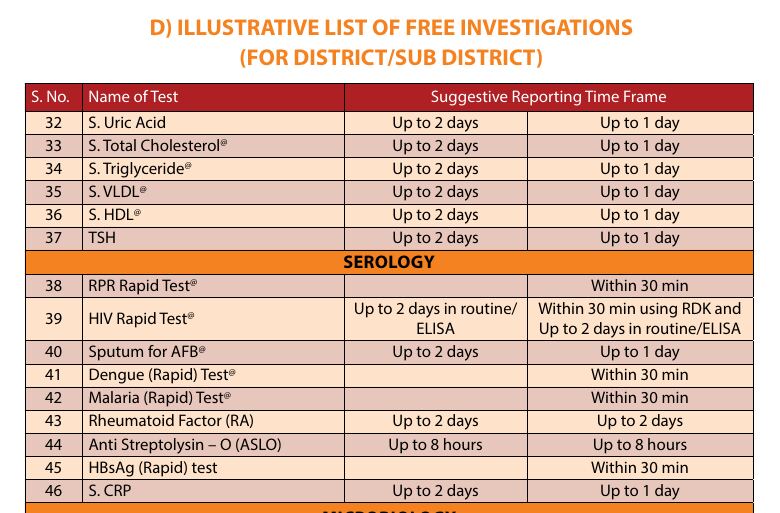
The National Health Mission's 2015 free-diagnostics list, by contrast, lists "Dengue (Rapid test)" as a free test at every level from sub-centre to district hospital. Both documents are official and they do not agree, so ask your hospital what it actually uses.
 Screenshot of NCVBDC (Ministry of Health)'s official page
What CGHS pays for dengue tests
CGHS, the Central Government Health Scheme, publishes the one official rate list. In the October 2025 memorandum (effective 13 October 2025), Tier I city rates are:
| CGHS item | Non-accredited lab | Accredited lab |
|---|---|---|
| LB269: Dengue NS1 Ag | ₹340 | ₹400 |
| LB270: Dengue IgM and IgG | ₹680 | ₹800 |
| LB013: Platelet count | ₹85 | ₹100 |
| LB012: Complete haemogram (CBC) | ₹255 | ₹300 |
Tier II cities are 10% lower and Tier III 20% lower. There is no separate CGHS row for IgM alone, IgG alone, PCR, or an NS1 + IgM + IgG combination.
 Screenshot of CGHS (Ministry of Health)'s official page
Against the labs above, the NS1 ceiling of ₹400 sits below every private price we read (₹588 to ₹800). CGHS rates apply to CGHS beneficiaries at empanelled labs. They are not a price cap for other patients, and they are not what a government hospital charges the public. For the other tests in a fever workup, see CGHS vs private lab prices.
Is dengue testing free at government hospitals?
Partly. Here is what the official sources actually say, and what we could not confirm.
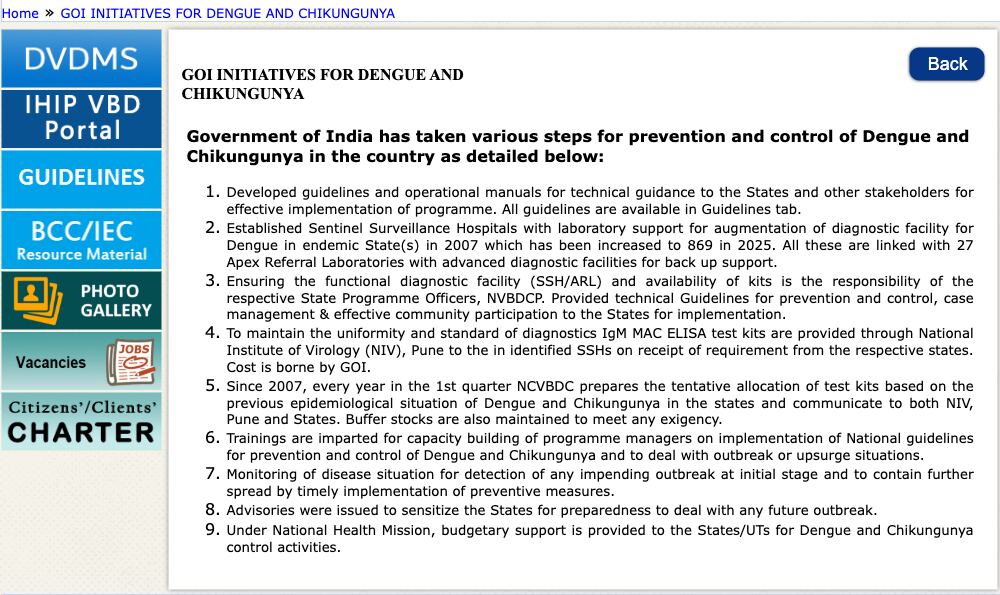
- What is free: IgM ELISA at sentinel hospitals. The NCVBDC site says sentinel surveillance hospitals with laboratory support have grown to 869 in 2025, linked to 27 apex referral laboratories. It says IgM MAC-ELISA test kits are provided through the National Institute of Virology, Pune, and that the "cost is borne by GOI". The list names hospitals in each state, for example K.E.M., Sion and Nair in Mumbai and ESI Hospital Basai Darapur in Delhi.
- What we could not find: NS1 free everywhere. No NCVBDC text we read says NS1 testing is free, or that testing is free at "all district hospitals and medical colleges". The list does not say who may use a sentinel hospital or whether you need an OPD referral. Call the hospital and ask which tests it does.
- Rapid tests. NHM's 2015 list includes a free rapid dengue test at all levels, though NCVBDC's 2023 guideline does not recommend rapid tests. States can add to the NHM lists.
- No published price. We found no government hospital price list that shows a dengue test rate, so we do not print one.
 Screenshot of NCVBDC (Ministry of Health)'s official page
 Screenshot of the National Health Mission's official page
Price caps on private labs
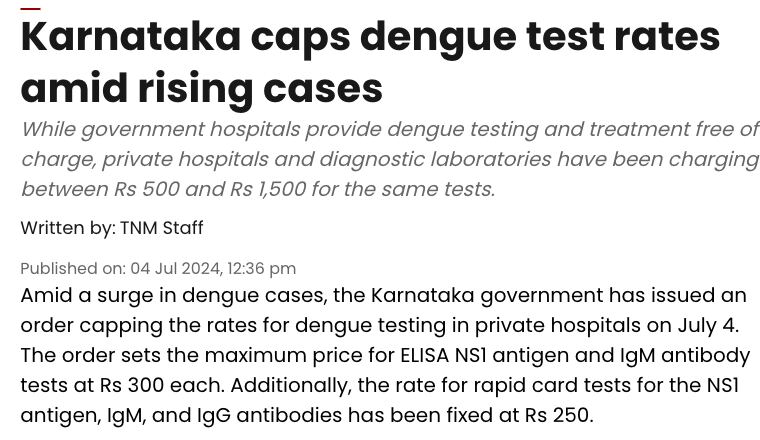
Some states have capped what private labs may charge. Both figures below come from news reports, not from the orders themselves, and we could not confirm that either is still in force:
- Karnataka: ₹300 each for ELISA NS1 and IgM, and ₹250 for rapid card tests, reported on 4 July 2024. The report says notices were sent to 22 Bengaluru facilities that month.
- Delhi: ₹600 each for NS1 and the antibody test, reported in September 2015. That is history, not today's rule.
We found no cap for Maharashtra, Tamil Nadu or Kerala. If a lab quotes you a price far above the range in this article, ask for the state rate and compare two other labs.
 Screenshot of a The News Minute news report
How many dengue cases does India report?
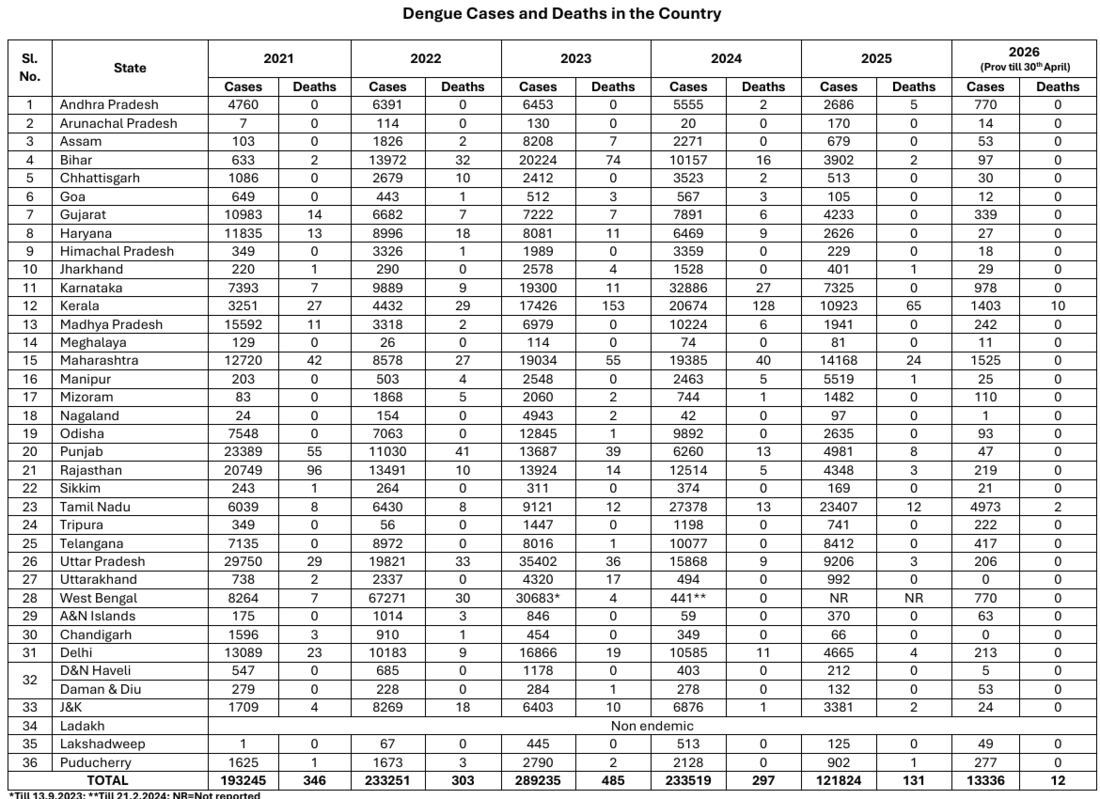
The NCVBDC table of "Dengue Cases and Deaths in the Country" shows 233,251 cases and 303 deaths in 2022, 289,235 and 485 in 2023, 233,519 and 297 in 2024, and 121,824 cases and 131 deaths in 2025 (West Bengal did not report for 2025). For 2026 the table showed 13,336 cases and 12 deaths up to 30 April. These are reported cases, and the real number of infections is higher, but we found no reliable source for how many times higher, so we do not quote a multiple.
 Screenshot of NCVBDC (Ministry of Health)'s official page
After the diagnosis: repeat blood counts and warning signs
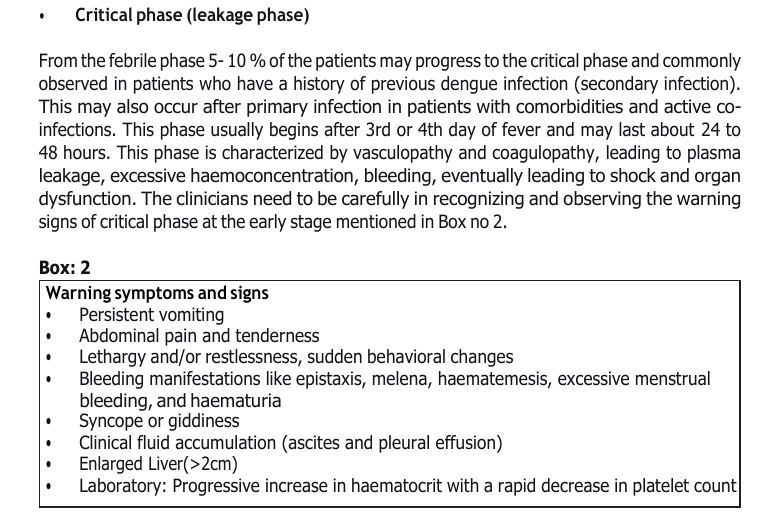
A dengue test confirms the diagnosis. What decides safety is watching the illness through the critical phase, which usually begins after the 3rd or 4th day of fever and may last about 24 to 48 hours.
- When to repeat a CBC. The NCVBDC guideline advises a CBC (with haematocrit and platelet count) for all patients with warning signs and all patients with fever beyond 3 days. WHO's 2009 guideline says outpatients should be reviewed daily until they are out of the critical period. No official text gives a day-by-day schedule for a family at home, so let the treating doctor set it.
- Cost of repeats. At the CBC prices in our CBC price guide, ₹250 to ₹449 per test, five daily counts come to about ₹1,250 to ₹2,250 before home-collection charges.
- Warning signs (NCVBDC, Box 2). Persistent vomiting, abdominal pain and tenderness, lethargy or restlessness, bleeding (nose, gums, black stools, vomiting blood, heavy periods, blood in urine), fainting or giddiness, fluid accumulation, an enlarged liver, and a rising haematocrit with a rapidly falling platelet count. These need urgent hospital assessment.
- Avoid aspirin and NSAIDs. NCVBDC and WHO both advise against aspirin, ibuprofen and similar drugs in dengue. Ask your doctor about fever relief.
 Screenshot of NCVBDC (Ministry of Health)'s official page
Platelet transfusion: the trigger is bleeding, not a number
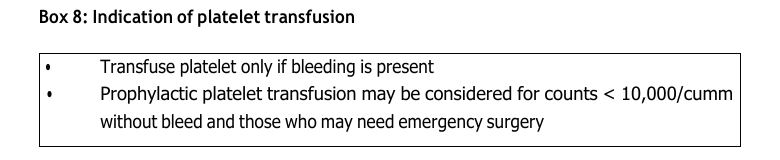
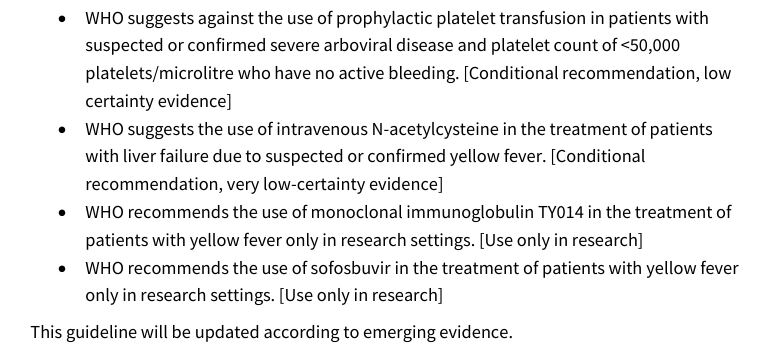
The guideline says to "transfuse platelet only if bleeding is present". It adds that prophylactic transfusion may be considered below 10,000 per cubic mm without bleeding, and for patients who may need emergency surgery. WHO's 2025 guideline suggests against prophylactic transfusion at counts below 50,000 when there is no active bleeding. A low platelet count on its own is not a reason to ask for a transfusion. To follow your counts day by day, use our dengue recovery tracker.
 Screenshot of NCVBDC (Ministry of Health)'s official page
 Screenshot of the World Health Organization's official page
Dengue, malaria, typhoid and chikungunya: the tests that go with it
In monsoon fevers doctors often test for several diseases at once, because they look alike early on and can occur together. A positive malaria test does not rule dengue out, and the reverse is also true. The CGHS ceiling rates for the other tests in a fever workup (Tier I, accredited lab) are:
| Test | CGHS rate |
|---|---|
| Malaria smear (LB018) | ₹100 |
| Malaria rapid card or QBC (LB026) | ₹100 |
| Widal (LB268) | ₹70 |
| Typhidot IgM (LB263) | ₹400 |
| Chikungunya IgM (LB333) | ₹1,000 |
For private lab prices on the whole panel, see dengue, malaria and typhoid test cost.
Is there a dengue vaccine in India?
As of 27 September 2026, a dengue vaccine has been approved but is not yet on sale. India's drug regulator CDSCO approved Qdenga (TAK-003) on 21 July 2026 for ages 4 to 60, as two doses three months apart, according to a Press Information Bureau release. On 18 September 2026 the manufacturer and its distributors announced distribution terms, with availability "anticipated" in the first half of 2027. We found no official word on whether it will join the national immunisation programme. Mosquito control and avoiding bites remain the main protection.
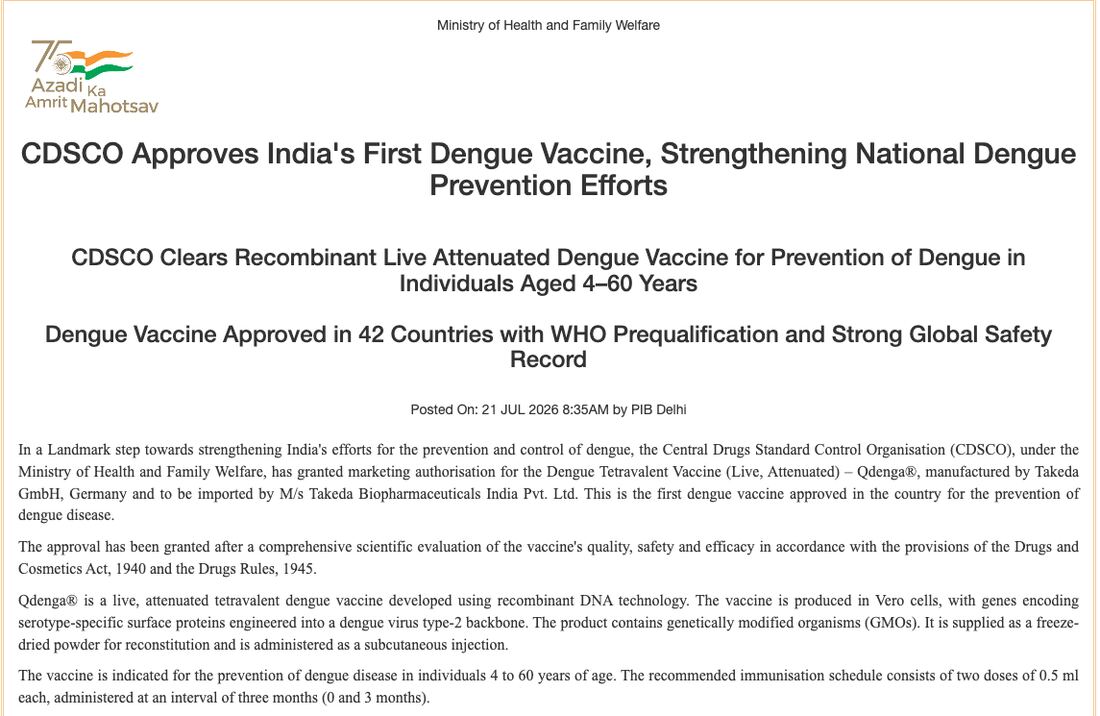 Screenshot of the Press Information Bureau's official page
How to pay less for a dengue test without cutting corners
- Ask the doctor which test you need for your day of fever. NS1 for days 1 to 5 and IgM after day 5 is the national rule. A single test at ₹600 beats a ₹2,000 panel you do not need.
- Ask about the method. Prefer ELISA or EIA to a rapid card for a diagnosis, and note that rapid cards were not cheaper at every lab.
- Compare two or three labs on the same day. For NS1 the spread was ₹212 (₹588 to ₹800). Change the city in the lab's URL or selector, because prices are city-specific.
- Check your entitlement. CGHS, ESI and state schemes cover the tests for members, and sentinel surveillance hospitals receive IgM ELISA kits free.
- Ignore MRP and "70% off". Compare only the amount you would pay.
- Do not repeat a test you already have. IgM can stay positive for weeks, and IgG for life, so a positive result after an old illness does not always mean a new infection. Keep your reports handy.
Keep your dengue reports in one place with Ayu
A dengue illness produces a small pile of reports in a week: NS1 or IgM, then a CBC every day. The trend in platelets and haematocrit is what a doctor wants to see.
- Scan each report with your phone and Ayu reads it into a structured record.
- Track the trend across days instead of comparing paper reports by eye.
- Share with any doctor instead of carrying a folder.
Related reading: dengue recovery and platelet tracking, CBC test price in India, and CGHS vs private lab prices.
Frequently Asked Questions
What people ask before booking a dengue test in India
Medical disclaimer
This article is for general information and does not replace advice from a doctor. Lab prices were read from each lab's public page on 27 September 2026, are indicative, vary by city and offer, and may have changed since. CGHS rates come from an official document dated 3 October 2025 and may be revised. Dengue can become serious quickly. If you have warning signs, go to a hospital. Your doctor decides which tests you need and how to read your results.