Somewhere between 45 and 50, most Indian women start noticing changes — periods that arrive early or late, nights that end in a hot flash, moods that swing without warning. The question that follows is usually the same: is this perimenopause, or something else? An FSH (Follicle Stimulating Hormone) and LH (Luteinising Hormone) blood test is often the first step toward an answer, but the panel is priced wildly differently depending on where you book it, and bundled with a different mix of hormones at every lab. We compared prices across major Indian labs and built a free calculator to help you place where you might be in the transition.
Key Takeaways:
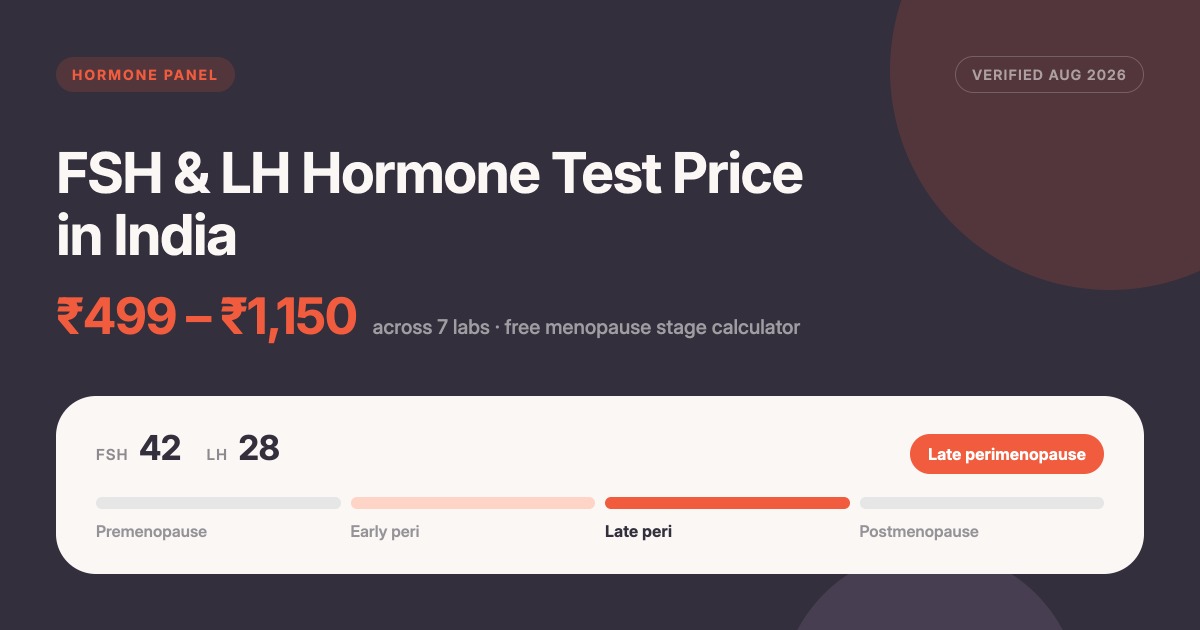
- Verified FSH/LH panel prices (August 2026) range from ₹494 (Healthians) to ₹1,700 (Metropolis) — the difference usually comes down to how many additional hormones (Prolactin, TSH) are bundled into the panel
- FSH rises sharply after menopause — a post-menopausal range of roughly 19.3–100.6 mIU/mL, compared to 1.4–9.9 mIU/mL in the follicular phase of a regular cycle
- Under the STRAW+10 staging framework used by menopause specialists worldwide, cycle length change is usually the earliest sign — before FSH itself moves clearly out of range
- No fasting required for either hormone
- Our calculator below estimates your likely stage in the transition from your age, cycle pattern, and symptoms
1. Estimate Your Menopause Stage
Answer three quick questions about your age, cycles, and symptoms to get an estimate of where you likely are in the menopause transition, based on the STRAW+10 staging system used by the International Menopause Society.
2. FSH/LH Hormone Panel Price Comparison — Verified August 2026
We checked each lab's live booking page for their FSH/LH panel and recorded the exact price and parameters included, cheapest first:
| Lab | Panel | Price | MRP | Discount |
|---|---|---|---|---|
| Healthians | Basic Female Hormones (FSH, LH, Prolactin) | ₹494 | ₹1,648 | 70% off |
| Redcliffe Labs | FSH & LH Test (2 parameters) | ₹999 | ₹2,775 | 64% off |
| Metropolis Healthcare | FSH LH TSH Prolactin Profile (4 parameters) | ₹1,700 | — | — |
| Dr Lal PathLabs | FSH/LH panel | ₹800–₹1,200 (varies by city) | — | Check lalpathlabs.com directly |
| Tata 1mg Labs | FSH/LH panel | Check 1mg.com for current price | — | — |
| Apollo 24|7 | FSH/LH panel | Check apollo247.com for current price | — | — |
| Thyrocare | FSH/LH panel | Check thyrocare.com for current price | — | — |
The three prices above (Healthians, Redcliffe, Metropolis) were captured live from each lab's own booking page with screenshots below. Lal PathLabs, Tata 1mg, Apollo 24|7 and Thyrocare prices weren't consistently reachable at the time of writing — their sites either timed out or the exact panel page had moved — so we've left those as "check directly" rather than guess. A useful comparison point: Metropolis' own city-price table shows this exact panel running ₹1,200 to ₹2,200 across Mumbai, Delhi, Bengaluru, Chennai, Pune and Ahmedabad, which gives a rough sense of the citywide range even where we couldn't verify a specific lab's live price.
A caveat that matters more here than for most blood tests: "FSH/LH test" isn't a standard bundle — some labs price FSH and LH alone, others bundle in Prolactin and TSH by default because all four are relevant to the same fertility/menopause questions. Compare on parameters included, not price alone.
See the Actual Listings
FSH / LH Hormone Panel — Live Price Screenshots
Captured 13 Aug 2026 · prices change, always confirm at checkout
3. What FSH and LH Actually Measure
FSH and LH are pituitary hormones that control the ovaries — FSH drives egg development through each cycle, and LH triggers ovulation. As the ovaries' supply of eggs declines with age, they respond less to FSH's signal, so the pituitary gland compensates by producing more of it. That rising FSH is the underlying reason FSH is used as a marker of ovarian reserve and menopause proximity, even though a single reading fluctuates enough month to month that doctors rarely diagnose from one result alone.
LH follows a similar upward pattern after menopause but is used less often on its own — it's usually ordered alongside FSH partly because a sharply skewed LH/FSH ratio is also a marker doctors check for PCOS, a completely different condition that can present with some overlapping symptoms (irregular cycles) at a younger age.
4. Reading Your FSH Result by Cycle Phase
FSH and LH reference ranges shift dramatically depending on where you are in your cycle — or whether you've stopped cycling altogether — which is exactly why the same lab report needs a cycle-day or menopause-status context to interpret correctly:
| Phase | FSH Range | LH Range |
|---|---|---|
| Follicular phase | 1.4–9.9 mIU/mL | 2.4–12.6 mIU/mL |
| Mid-cycle peak | 0.2–17.2 mIU/mL | 14–95.6 mIU/mL |
| Luteal phase | 1.1–9.2 mIU/mL | 1–11.4 mIU/mL |
| Postmenopausal | 19.3–100.6 mIU/mL | 7.7–58.5 mIU/mL |
The postmenopausal range is strikingly higher than any pre-menopausal phase — which is why a single FSH reading well above 19–20 mIU/mL, especially paired with skipped periods, is one of the stronger lab signals that the transition is well underway. A single elevated reading during perimenopause itself is far less conclusive, since FSH can swing widely from one cycle to the next during this phase specifically.
5. The STRAW+10 Staging System, in Plain Language
STRAW+10 is the staging framework menopause specialists use to describe where a woman is in the reproductive-to-postmenopausal transition, and it leans more on cycle pattern than on any single hormone level:
- Late Reproductive Stage — cycles are still regular, but subtle hormonal shifts may already be starting underneath
- Early Perimenopause — cycle length starts varying by 7 or more days from what's typical for you, while periods continue
- Late Perimenopause — periods are skipped for 60 days or more at a stretch; this stage is usually shorter (1 to 3 years) and closer to the final period
- Postmenopause — defined retrospectively, once 12 consecutive months have passed with no period at all
Dr. Kulkarni sees this play out often in clinic: "Patients frequently come in asking for a hormone test to 'confirm' menopause, expecting a clear yes-or-no answer. I explain that cycle pattern usually tells us more than the FSH number does — the blood test is there to support the picture, not replace it."
6. Who Should Test, and When
An FSH/LH test is most useful in two fairly different situations: women in their 40s with genuinely confusing symptoms (is this perimenopause or a thyroid issue or something else?), and younger women being evaluated for fertility concerns or suspected premature ovarian insufficiency. For a woman in her late 40s with classic symptoms and skipped periods, the test is often more confirmatory than diagnostic — the cycle pattern has usually already told the story. Testing is most clarifying when symptoms are ambiguous, cycles are still fairly regular, or there's a specific reason to rule out another condition, such as a thyroid disorder, that can mimic several perimenopausal symptoms.
7. Beyond FSH and LH
If your FSH/LH result is ambiguous or your doctor wants a fuller hormonal picture, the next tests typically added are Estradiol (the primary circulating oestrogen, which falls as menopause approaches) and AMH (Anti-Müllerian Hormone, a more stable marker of remaining egg count that doesn't fluctuate with the cycle the way FSH does — we've compared AMH prices and built a calculator for it separately). A TSH (thyroid) test is also commonly bundled in, since hypothyroidism can cause irregular periods and fatigue that closely mimic early perimenopause.
8. People Also Ask
Can FSH be normal even during perimenopause?
Yes. FSH fluctuates significantly during perimenopause and can swing between elevated and near-normal readings from one cycle to the next — a single normal FSH doesn't rule out perimenopause, particularly if cycle changes and symptoms are already present.
Is fasting required for an FSH/LH test?
No. Neither hormone requires fasting, though your doctor may specify a particular cycle day (commonly day 2 or 3) for the blood draw, since both hormones vary through the month in women who are still cycling.
What is the difference between FSH and AMH for checking menopause proximity?
FSH fluctuates with the menstrual cycle and rises as menopause approaches, making a single reading less reliable on its own. AMH is more stable day to day and reflects the ovaries' remaining egg supply more directly, which is why some doctors prefer it as a first-line marker — though the two are often ordered together for a fuller picture.
Which lab has the cheapest FSH/LH test in India?
In our August 2026 check, Healthians' Basic Female Hormones panel (₹494) was the cheapest of the labs we could verify live, though it's worth checking exactly which hormones are included before comparing purely on price.
Can birth control pills affect FSH/LH results?
Yes. Hormonal contraceptives suppress natural FSH and LH production, so results while on the pill (or shortly after stopping) won't accurately reflect your underlying hormonal status — mention any hormonal medication to your doctor before testing.
9. Conclusion
FSH/LH testing costs more than three times as much depending purely on which lab and which bundled panel you choose — but the number itself is only part of the picture. Cycle pattern, symptoms, and the trend across more than one test typically tell a menopause specialist more than any single hormone reading in isolation.
Store every hormone test result in Ayu, alongside a note of your symptoms and last period date at the time — that combined record is what turns a handful of scattered lab reports into a picture your gynaecologist can actually use.
10. Medical Disclaimer
This article, including the menopause stage calculator, is for educational purposes only and does not replace clinical evaluation. Prices listed were verified at the time of writing and may have changed — always confirm current pricing directly with the lab before booking. The calculator provides a staging estimate based on self-reported cycle and symptom information, not a diagnosis; consult a gynaecologist for confirmation and personalised guidance, especially before starting or stopping any hormone therapy.