Hormone Replacement Therapy has a reputation problem in India — many women assume it's expensive, complicated, or "not really necessary," and never get as far as asking their doctor what it actually costs. The reality, at least for the most commonly prescribed oral form, is a lot less dramatic than the reputation: a month's strip of estradiol valerate tablets costs less than a typical dinner out. We checked live pharmacy prices and built a free symptom severity checklist to help you gauge whether HRT is worth raising with your doctor in the first place.
Key Takeaways:
- Verified estradiol valerate (Progynova 2mg) prices (August 2026) range from ₹450 to ₹574 per 28-tablet strip — roughly a month's supply at the standard starting dose
- HRT is generally most effective for vasomotor symptoms (hot flashes, night sweats) and vaginal dryness — it isn't primarily prescribed for mood or weight changes alone
- Oestrogen-only tablets are for women without a uterus; women with a uterus intact are usually prescribed oestrogen alongside a progestogen to protect the uterine lining
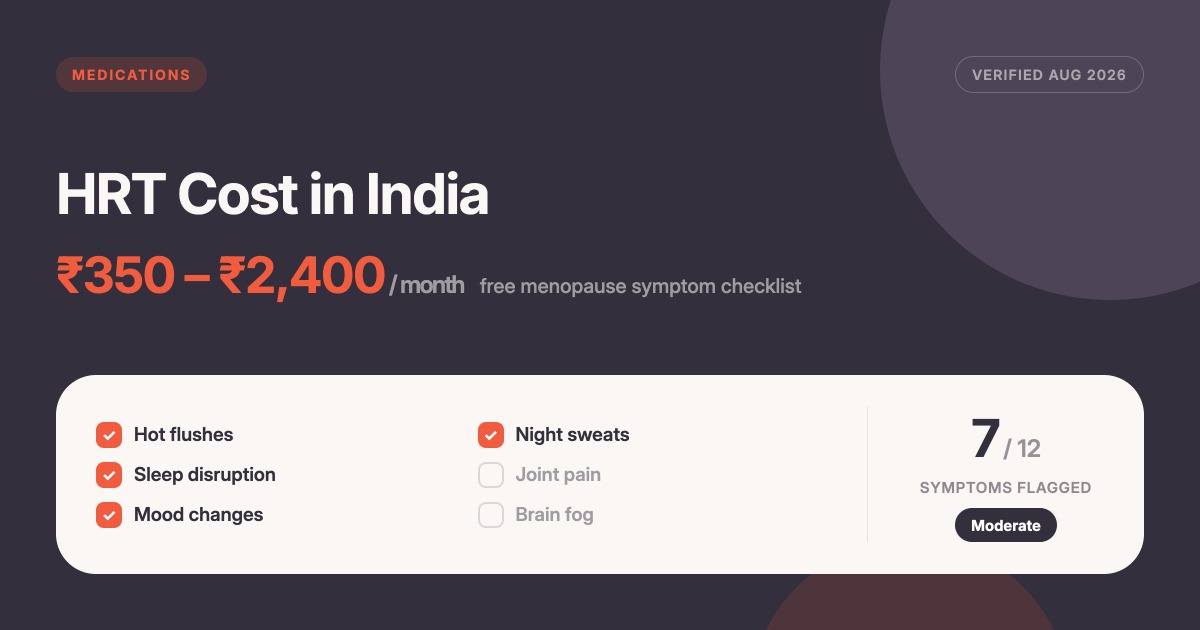
- Our checklist below scores your symptom severity across 7 common menopause symptoms to help frame a conversation with your doctor
- HRT candidacy depends on personal and family history of blood clots, breast cancer, heart disease and stroke — a doctor's assessment, not this checklist, makes that call
1. Check Your Symptom Severity
Rate each symptom from the last two weeks to get a sense of your overall symptom burden — useful context to bring into a conversation with your gynaecologist about whether HRT (or other options) might help.
2. HRT Medicine Price Comparison — Verified August 2026
Estradiol valerate (brand name Progynova, among others) is the most widely prescribed oral oestrogen for HRT in India. We checked live prices at two pharmacies for the standard 2mg, 28-tablet strip:
| Pharmacy | Product | Price | MRP | Discount |
|---|---|---|---|---|
| Netmeds | Progynova 2mg Tablet, 28's | ₹515.84 | ₹644.00 | 20% off |
| Apothecare | Progynova 2mg Tablet, 28's | ₹450.00 | ₹590.63 | 24% off |
A 28-tablet strip is typically a one-month supply at the standard starting dose, though your doctor sets the exact regimen. Both prices above were captured live from each pharmacy's own product page, with screenshots below.
Beyond tablets, oestrogen gels (such as Oestrogel and Divigel) are also available in India and applied directly to the skin — a route some women and doctors prefer since it avoids the liver processing that oral tablets require. We didn't independently verify live gel pricing for this comparison, but patient-facing pricing guides put gel-based HRT in a broadly similar monthly cost range to tablets — confirm current pricing with your pharmacist, since gel availability varies more by city than tablets do. Transdermal patches, common in Western HRT prescribing, have more limited retail availability in India and are often special-ordered rather than stocked at a typical pharmacy.
If you have a uterus, your doctor will very likely also prescribe a progestogen (commonly medroxyprogesterone or micronised progesterone) alongside oestrogen, to protect the uterine lining from unopposed oestrogen exposure — factor this second medicine into your actual monthly cost, since the tables above cover oestrogen alone.
See the Actual Listings
Estradiol Valerate (Progynova 2mg, 28 Tablets) — Live Price Screenshots
Captured 13 Aug 2026 · prices change, always confirm at checkout
3. What HRT Actually Does
HRT replaces the oestrogen (and, when needed, progesterone) that the ovaries stop reliably producing through perimenopause and after menopause. Falling oestrogen is the underlying driver of most classic menopause symptoms — hot flashes and night sweats happen because oestrogen influences the brain's temperature-regulation centre; vaginal dryness happens because oestrogen keeps vaginal tissue elastic and lubricated. Replacing that hormone, at the lowest effective dose for the shortest duration that controls symptoms, is the general principle behind modern HRT prescribing.
It's worth being specific about what HRT is good evidence for: vasomotor symptoms and vaginal/urogenital symptoms have the strongest evidence for benefit. Mood, weight gain, and brain fog can improve for some women but are less predictably tied to HRT alone, and your doctor may explore other causes or treatments alongside it for those specifically.
4. Who Is (and Isn't) Usually a Candidate
Current international guidance broadly supports HRT as a reasonable option for most healthy women under 60, or within 10 years of their final period, who have bothersome menopausal symptoms and no specific contraindications. Contraindications your doctor will screen for include a personal history of breast cancer, unexplained vaginal bleeding, active blood clots (deep vein thrombosis or pulmonary embolism), certain liver conditions, and a history of oestrogen-sensitive cancers. Family history — particularly of breast cancer or blood clots — is also part of the conversation, though it doesn't automatically rule HRT out on its own.
Dr. Kulkarni sees a common pattern in her own practice: "A lot of women arrive having already decided HRT is 'too risky,' based on outdated information from the early 2000s. Current guidance is considerably more nuanced — for most healthy women with significant symptoms and no contraindications, the benefit-risk conversation looks quite different today than it did twenty years ago."
5. Starting the Conversation With Your Doctor
If your symptom checklist score above lands in the moderate-to-severe range, a useful way to start the conversation is by bringing that score, along with how long you've had symptoms and how they're affecting daily life (sleep, work, relationships) — specifics your doctor can act on more directly than a general "I think I might be going through menopause." Worth asking about specifically: whether oral tablets or a transdermal option (patch or gel) suits your health history better, since transdermal oestrogen carries a lower blood clot risk for some women; what monitoring or follow-up is expected once you start; and how long a typical course runs before it's reassessed.
6. Non-Hormonal Options Worth Knowing About
HRT isn't the only option, and for some women — particularly those with a personal history that makes HRT inadvisable — it isn't the right one. Non-hormonal medications (certain antidepressants at low doses have evidence for reducing hot flash frequency), lifestyle measures (regular exercise, reduced alcohol and caffeine, layered clothing, cooling strategies), and vaginal moisturisers or lubricants for dryness specifically are all legitimate paths, sometimes used alongside HRT and sometimes instead of it. This is worth raising directly if HRT doesn't feel like the right fit for you.
7. People Also Ask
Is HRT safe to take long-term?
Current international guidance generally supports HRT at the lowest effective dose for as long as symptoms warrant it and benefits continue to outweigh risks for that individual woman — this is a personalised, ongoing decision made with your doctor rather than a fixed time limit that applies to everyone.
How soon does HRT start working?
Vasomotor symptoms like hot flashes often improve within a few weeks of starting HRT, though it can take a few months to feel the full effect, and your doctor may adjust your dose during that period.
Can I take HRT if I still have periods?
Yes, HRT can be started during perimenopause while periods are still occurring, though the specific formulation and dosing regimen your doctor recommends may differ from what's used after periods have fully stopped.
What's the difference between HRT tablets, gels, and patches?
All deliver oestrogen, but tablets are processed through the liver (oral route), while gels and patches are absorbed through the skin (transdermal route), which some doctors prefer for women with certain risk factors since it bypasses first-pass liver metabolism. Your doctor's recommendation depends on your specific health history.
Does HRT cause weight gain?
Weight changes around menopause are common but are more strongly linked to ageing, muscle mass changes, and metabolism shifts than to HRT itself — most current evidence doesn't support HRT as a direct cause of significant weight gain.
8. Conclusion
The oestrogen tablet itself — the core cost of oral HRT — runs a modest ₹450 to ₹574 a month at the pharmacies we checked, considerably less than many women assume before actually pricing it. The real cost consideration is usually the doctor consultation, any required monitoring, and a second medicine (progestogen) if you have a uterus — not the headline HRT medicine price.
Store your symptom checklist results and prescription details in Ayu, so your gynaecologist can see how your symptoms actually changed over the following months, not just what you remember at your next appointment.
9. Medical Disclaimer
This article, including the symptom severity checklist, is for educational purposes only and does not replace clinical evaluation. Prices listed were verified at the time of writing and may have changed — always confirm current pricing and availability directly with the pharmacy before ordering. This checklist screens for symptom burden only; it is not a diagnostic tool, and HRT candidacy depends on a full personal and family health history that only a doctor can assess. Do not start, stop, or change any hormone therapy without consulting a qualified physician.